Beginner Roadmap to Prop Firm Trading
If you’re new to prop firm trading, read these guides in order.
1️⃣ What Is a Prop Firm Challenge
➡ Read the full guide here.
2️⃣ Best Prop Firm Challenges for Beginners
➡ Compare beginner-friendly firms.
3️⃣ Prop Firm Drawdown Rules Explained
➡ Understand the most important risk rule.
4️⃣ Why Prop Firms Have Consistency Rules
➡ Learn how prop firms evaluate traders.
5️⃣ How Long It Takes to Pass a Prop Firm Challenge
➡ Realistic expectations for beginners.
Many traders hear about funded trading accounts very early in their journey. The idea sounds simple: pass a challenge and trade a large account without risking your own savings.
Because of this, beginners often rush into a prop firm evaluation before they understand what the challenge is actually testing.
Most assume the test is about predicting the market correctly.
It isn’t.
Prop firms are not primarily evaluating your strategy. They are evaluating your behavior, specifically your ability to control risk and follow rules under pressure. Traders who misunderstand this often repeat challenges multiple times, believing their strategy is the problem when the real issue is discipline.
Understanding how prop firms actually work can save a new trader significant frustration, time, and money.
Why Prop Firms Exist
Prop firms are businesses, not trading schools and not investors giving away capital.
Their goal is to identify traders who can follow a structured risk framework. A trader who occasionally makes large profits but also takes large losses is unpredictable. A trader who controls losses consistently can be scaled.
The evaluation process exists to answer one question:
Can this trader protect capital?
This helps beginners stop viewing the challenge as a race and start viewing it as a behavior test.
What Is a Prop Firm?
A proprietary trading firm (prop firm) is a company that allows traders to trade with the firm’s capital instead of their own money.
Instead of depositing thousands of dollars into a broker account, a trader pays a smaller evaluation fee. The trader must then follow strict risk rules over a testing period. If the trader passes the evaluation, the firm provides a funded account and the trader earns a percentage of the profits.
In simple terms:
You are not being hired.
You are being tested.
The prop firm’s business model is built around identifying traders who can control risk, not traders who can win a few trades.
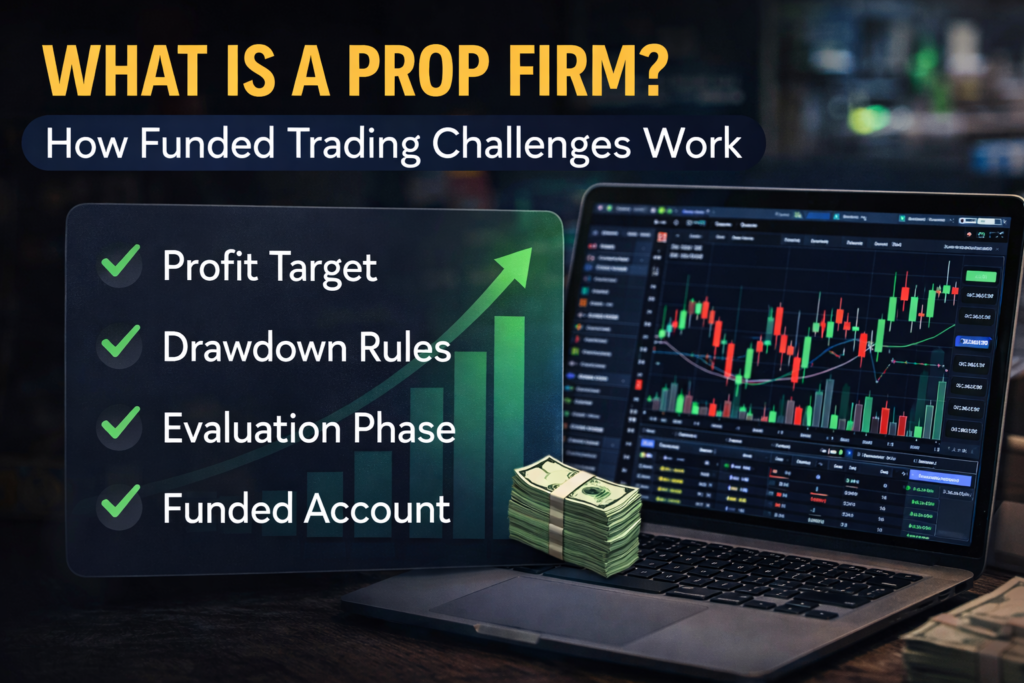
How Prop Firm Challenges Actually Work
Most prop firms require traders to pass a structured evaluation. While each company is slightly different, the core rules are very similar:
• Maximum daily loss limit
• Maximum overall drawdown
• Profit target
• Minimum trading days
• Consistent position sizing
The evaluation is not measuring how aggressive you are.
It is measuring whether you behave like a risk manager.
This is where beginners run into problems. They approach the challenge like a race, when the firm designed it like a discipline test.
My First Challenge Experience
When I first attempted a funded challenge, I made the same mistake many beginners make. I rushed trades, increased position size trying to pass quickly, and treated the evaluation like a short-term opportunity instead of a discipline test. It took several failed attempts before I understood the firms were not testing profitability; they were testing consistency. Once I slowed down and focused on protecting the account rather than growing it quickly, my results improved significantly.
Why Most Traders Fail
Most traders do not fail because they cannot read a chart. They fail because their expectations are unrealistic.
New traders often:
• Trade too large relative to the account
• Try to pass in one or two trades
• Overtrade after a winning day
• Revenge trade after a losing trade
• Ignore daily loss limits
Most traders try to pass the challenge quickly.
Successful traders try to avoid violating rules.
Prop firms are specifically designed to expose emotional trading behavior. The challenge is not a trading skill test; it is a psychological and risk management test.
A trader who risks 0.5% to 1% per trade has a dramatically higher probability of passing than a trader who risks 5% attempting to pass quickly.
To understand how most traders actually violate evaluations, you need to understand how drawdown limits work.
Should Beginners Start With a Funded Challenge?
A funded account can be a powerful opportunity, but only when approached correctly.
Before attempting a prop firm challenge, a trader should already understand:
• basic risk management
• position sizing
• how drawdown works
• realistic return expectations
Without those, the evaluation fee becomes tuition instead of opportunity.
A funded challenge should come after education and preparation, not before it.
For a step-by-step starting point, read the beginner guide here: Beginner Forex Guide
Final Thoughts
A prop firm challenge is not a shortcut to income. It is a structured environment designed to build discipline.
Traders who approach evaluations as a quick way to make money often repeat challenges. Traders who treat them as a learning process tend to improve and eventually succeed.
Before attempting a challenge, traders should understand risk management, position sizing, and how drawdown limits work.
If you are just getting started, continue with these guides:
Step 1: Choose the Right Firm
➡ How Beginners Should Choose a Prop Firm
Step 2: Understand Why Traders Fail
➡ Why Many Traders Fail After Passing a Prop Firm Challenge
Step 3: Learn How Leverage Works
Step 4: Can You Copy Trade a Prop Firm Account?
Many new traders wonder if they can pass prop firm challenges using signal services or trade copiers.
However, most prop firms have strict rules about this.
➡ Can You Copy Trade a Prop Firm Account?
Transparency & Disclosure
TraderDecisions is an educational website.
We do not sell signals, trading systems, or financial advice.
Trading involves significant risk and most retail traders lose money. The purpose of this website is to help traders understand rules, risk, and realistic expectations before risking capital.
Some links on this site may be affiliate links, which means we may earn a commission at no extra cost to you. This does not influence our reviews; firms are discussed based on trader usability and beginner safety.
About the Author
Orbin Johnson is an active forex trader focused on risk management, funded accounts, and beginner trader education. His work centers on helping new traders avoid common early mistakes before risking real capital.