One of the most confusing parts of a prop firm challenge is not the strategy.
It is the rules.
Many traders believe they failed a challenge because of bad trading decisions.
In reality, they failed because they misunderstood drawdown.
A trader can:
• be profitable overall
• win more trades than they lose
• follow a plan correctly
—and still lose the account.
Why?
Because prop firms do not measure only profit.
They measure risk behavior.
And the main tool they use to measure it is drawdown rules.
Understanding daily loss and maximum loss is more important than learning a new trading strategy.
Without it, a trader can pass analysis… but fail the evaluation.
If you’re new to prop firm challenges, start here first:
👉 How Prop Firm Challenges Actually Work (Complete Beginner Guide)
What Drawdown Actually Means
Drawdown is not simply “losing money.”
Drawdown is the amount an account declines from a defined reference point.
Prop firms are not primarily evaluating whether you can make money.
They are evaluating whether you can control risk while trading under pressure.
The rules exist to answer one question:
Can this trader be trusted with larger capital?
A trader who makes profit but violates risk limits is considered unsafe.
A trader who makes slower profit but protects the account is considered consistent.
This is why many traders feel shocked when their account closes even though they were close to the profit target.
They were watching profit.
The firm was watching risk.
The Core Drawdown Rule
While prop firms use multiple risk rules, the most important concept to understand is drawdown.
Drawdown determines how much your account can decline before the challenge ends.
👉 If you want a simple comparison between daily loss and drawdown, read:
Prop Firm Daily Loss vs Drawdown
Daily Loss (Brief Context)
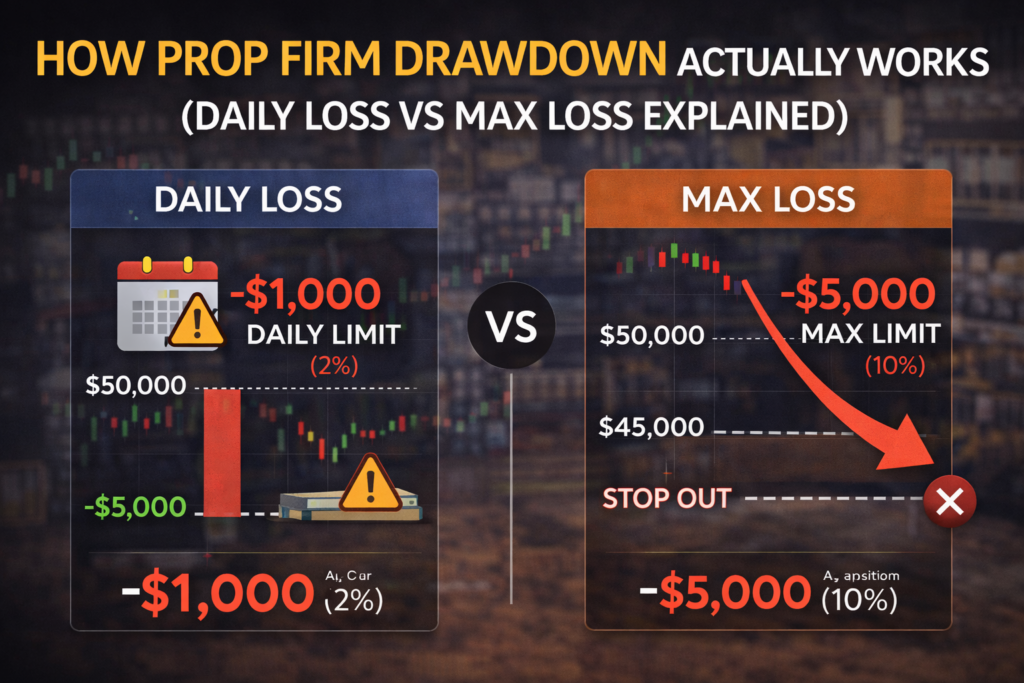
Most prop firms also use a daily loss limit, which restricts how much you can lose in a single day.
However, the real challenge for most traders is not the daily limit — it is how drawdown behaves over time.
👉 See full comparison here:
Prop Firm Daily Loss vs Drawdown
Maximum Loss Limit (The Account Protector)
The maximum loss limit is the total amount the account can decline overall during the entire challenge.
Example:
$100,000 account
Max Loss: 10%
If the account equity reaches $90,000 at any point → the evaluation ends permanently.
Unlike the daily rule, this does not reset.
It tracks your worst point during the entire evaluation.
This rule is not about a bad day.
It is about overall risk behavior.
A trader who constantly approaches the max loss is showing unstable trading habits.
The firm is not trying to punish the trader.
The firm is filtering for discipline.
Why Traders Fail Even When They Are Close to Passing
Here is a very common scenario:
A trader reaches +7% profit on a 10% target.
They feel close.
They increase position size.
One trade loses more than expected.
Instead of accepting the loss, they try to recover quickly.
They open another trade.
The market moves slightly against them.
The daily loss is breached.
Challenge ends.
The strategy did not fail.
The trader’s reaction to pressure failed.
Drawdown rules are designed specifically to reveal this behavior.
The Hidden Problem: Position Size
Most drawdown violations come from one thing:
Position size relative to stop loss.
Many beginners calculate risk incorrectly.
They think:
“I only lost 2 trades.”
But each trade was risking too much.
Example:
Risking 2% per trade
Two losses in a volatile session
- spread + floating drawdown
→ Daily loss breached.
The trader believes the system is unlucky.
The real issue is risk per trade.
Prop firms are not testing if you can win trades.
They are testing whether you can survive losing trades.
How Drawdown Builds Over Time
Drawdown does not usually happen in one trade.
It builds slowly through a series of small losses.
For example:
- 3–4 small losses in a row
- slightly increasing position size
- trading during high volatility
Individually, these decisions may seem harmless.
But together, they push the account closer to the maximum loss limit.
This is why traders often feel like they “suddenly failed.”
In reality, the drawdown was building long before the final trade.
The Correct Way to Think About a Challenge
A prop firm challenge is not a profit test.
It is a risk management test disguised as a profit target.
The profit target exists to prevent inactivity.
The drawdown rules exist to evaluate behavior.
Successful traders approach the challenge differently:
They do not aim to pass quickly.
They aim to avoid violations.
Ironically, traders who focus on protecting the account often pass faster than traders trying to reach the target aggressively.
The Key Insight
The challenge is not asking:
“Can you make 10%?”
It is asking:
“Can you trade for 30 days without losing control?”
Once you understand that, trading decisions change:
• fewer trades
• smaller position size
• more patience
• less emotional pressure
And the evaluation becomes much easier.
Why This Matters Before Buying a Challenge
Many beginners purchase multiple evaluations thinking they need a better strategy.
Often they need a better understanding of the rules.
Before attempting a challenge, a trader should already know:
• how much they can risk per trade
• how many losses they can take in a day
• how floating drawdown affects open trades
Without this, the challenge becomes gambling with evaluation fees.
With it, the challenge becomes manageable.
Why drawdown rules and consistency rules work together
Why Drawdown Rules Matter When Choosing a Prop Firm
Different prop firms structure drawdown rules differently.
Some use trailing drawdown, which is harder to manage.
Others use fixed drawdown, which is more predictable.
👉 To compare firms based on these rules, read:
Best Prop Firms for Beginners (2026 Honest Comparison)
Conclusion
Most traders do not fail a prop firm challenge because they cannot analyze the market.
They fail because they misunderstand drawdown.
Daily loss limits protect the firm from emotional decisions.
Maximum loss limits protect the firm from inconsistent traders.
A trader who learns to operate inside those limits is already demonstrating the core skill prop firms are looking for:
control.
Once risk is controlled, profit becomes possible.
Without risk control, profit cannot be kept — even if it appears briefly.