Most new traders spend their time learning entries.
They study indicators, chart patterns, and strategies hoping to predict price movement. They believe if they can just find the “right setup,” consistency will follow.
Professional traders approach the market differently.
They do not start by asking where to enter.
They start by asking how much they can afford to lose if they are wrong.
That is risk management.
Risk management is not a technical concept.
It is a survival system.
What Risk Management Actually Means
Many beginners misunderstand risk management. They assume it means trading cautiously, avoiding trades, or taking small profits.
It does not.
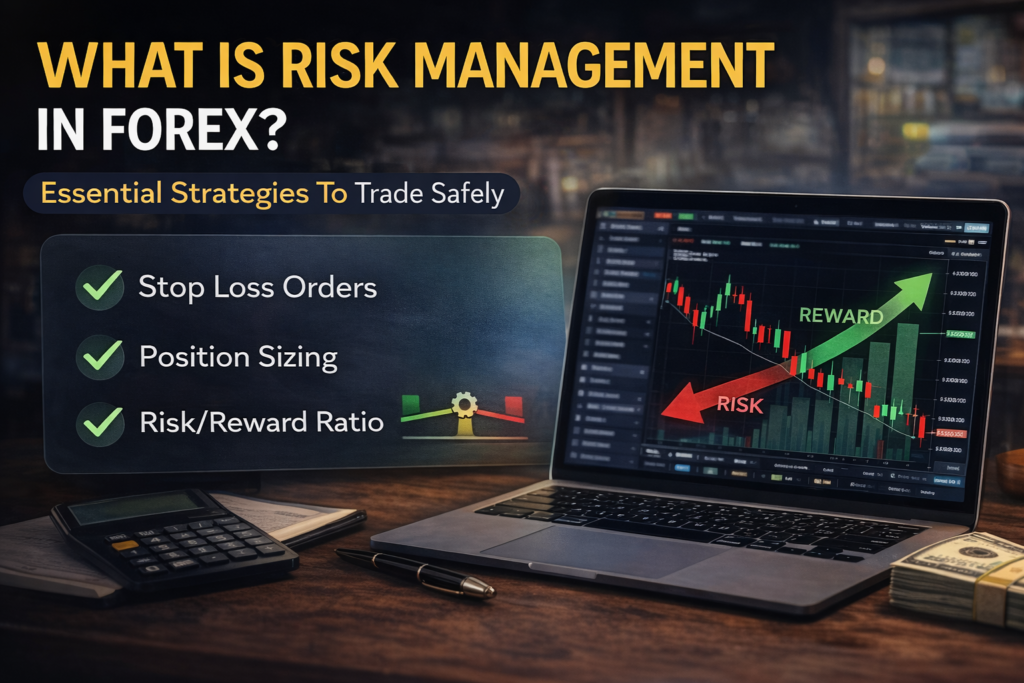
Risk management is simply controlling how much damage a single trade can do to your account.
It is not about winning trades.
It is about preventing one mistake from ending your trading career.
Risk management is:
• controlling position size
• controlling drawdown
• staying in the market long enough to improve
A trader rarely fails because of one bad trade.
A trader fails because one trade was allowed to matter too much.
The 1% Rule
A simple guideline many consistent traders follow is risking no more than 1% of their account on a single trade.
Why?
Because trading contains uncertainty. Even a perfect setup can fail.
If a trader risks 1% per trade:
10 losses in a row → the account is still healthy
If a trader risks 10% per trade:
a short losing streak → the account is gone
The difference between beginners and long-term traders is not win rate.
It is how survivable their losing streaks are.
Even strong risk management can fail if you don’t understand how prop firm drawdown is calculated.
My Personal Experience
Early in my trading, I focused almost entirely on setups and entries. I believed finding the right pattern would fix my results.
It did not.
The largest improvement in my trading came when I stopped trying to improve my wins and instead controlled my losses. Once I limited how much I could lose on each trade, my results became consistent.
Nothing about the market changed.
Only my risk did.
Why Prop Firms Care About Risk Management
This is also why proprietary trading firms focus heavily on drawdown rules.
Prop firms are not primarily evaluating strategy. They are evaluating behavior.
Their rules — daily loss limits, maximum drawdown, and consistency requirements, exist to measure how a trader manages risk, not how often they win.
A trader who occasionally makes large profits but allows uncontrolled losses cannot be trusted with capital.
A trader who protects capital consistently can be scaled.
Why Most Traders Fail Prop Firm Challenges
The Real Purpose of Risk Management
Risk management is not something traders add after they become profitable.
Risk management is what allows a trader to ever become profitable.
Strategies improve over time.
Psychology improves over time.
Experience improves over time.
But only if the account survives long enough.
Before learning advanced strategies, a trader must first learn how to stay in the game.
Because in trading, survival comes before success.
Before attempting a challenge, traders should also understand how to choose a stable company. You can read that here.
How to Choose a Safe Prop Firm (Before You Pay for a Challenge)
Why Most Forex Traders Blow Their First Account
Transparency & Disclosure
TraderDecisions is an educational website.
We do not sell signals, trading systems, or financial advice.
Trading involves significant risk and most retail traders lose money. The purpose of this website is to help traders understand rules, risk, and realistic expectations before risking capital.
Some links on this site may be affiliate links, which means we may earn a commission at no extra cost to you. This does not influence our reviews; firms are discussed based on trader usability and beginner safety.
About the Author
Orbin Johnson is an active forex trader focused on risk management, funded accounts, and beginner trader education. His work centers on helping new traders avoid common early mistakes before risking real capital.