
Many new traders entering prop firm challenges misunderstand the difference between daily loss limits and maximum drawdown.
At first glance, these rules appear similar because both limit how much money you can lose. However, they serve very different purposes in a prop firm evaluation.
Understanding how these two rules work together is critical. Most failed prop firm challenges happen because traders violate one of these limits without realizing it.
If you’re new to prop firm trading, start with this guide first:
➡ What Is a Prop Firm Challenge
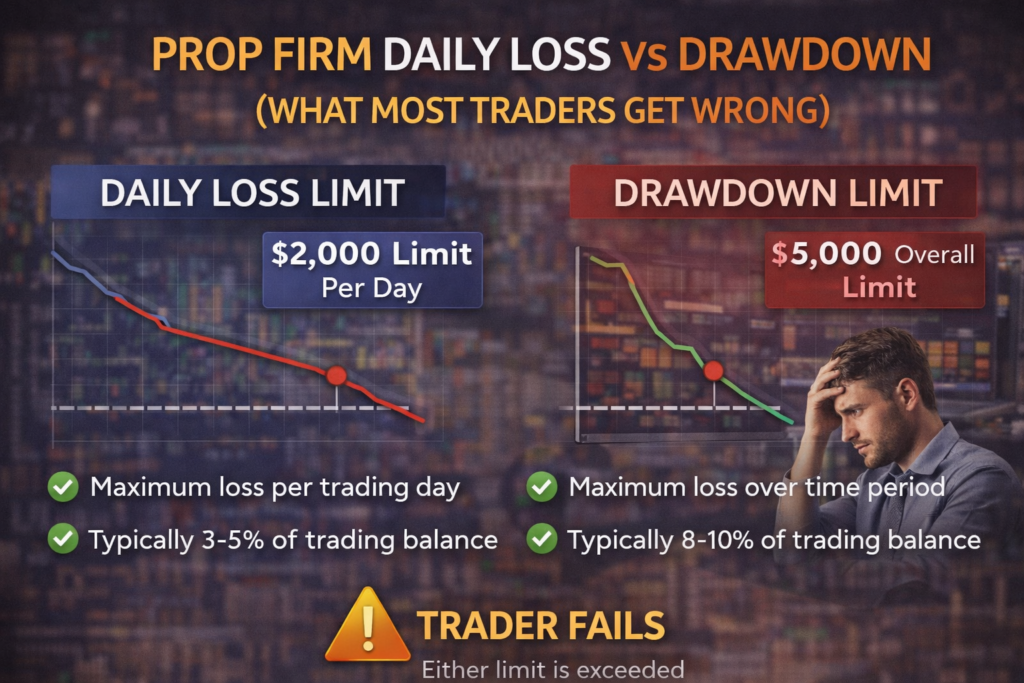
What Is a Prop Firm Daily Loss Limit?
The daily loss limit is the maximum amount of money you are allowed to lose within a single trading day.
Most prop firms calculate this based on either:
• starting account balance
• equity during the trading day
For example:
Account Size: $100,000
Daily Loss Limit: 5%
Maximum loss allowed in one day = $5,000
If your losses exceed that amount within the same trading day, the challenge is automatically failed.
This rule exists to ensure traders maintain discipline and avoid revenge trading.
Understanding this rule is part of proper risk management.
➡ Prop Firm Drawdown Rules Explained
What Is Prop Firm Maximum Drawdown?
Maximum drawdown is the total loss allowed on the account during the entire evaluation period.
Unlike the daily loss rule, this limit applies across multiple trading days.
Example:
Account Size: $100,000
Maximum Drawdown: 10%
This means the account balance can never fall below $90,000.
If the balance drops below that level at any point, the account fails immediately.
Drawdown rules are one of the most important concepts traders must understand before attempting a challenge.
➡ Why Prop Firms Have Consistency Rules
The Key Difference Between Daily Loss and Drawdown
Many traders assume these rules are the same. They are not.
| Rule | Purpose |
|---|---|
| Daily Loss Limit | Prevents large losses in a single day |
| Maximum Drawdown | Limits total account loss over time |
Daily loss controls short-term risk.
Drawdown controls overall account survival.
Both rules work together to ensure traders maintain responsible risk management.
Example of How Both Rules Work Together
Imagine a trader with a $100,000 challenge account.
Daily Loss Limit: 5%
Maximum Drawdown: 10%
Day 1
Trader loses $3,000 → account now $97,000
Day 2
Trader loses $4,000 → account now $93,000
Day 3
Trader loses $3,500
Now the account falls below $90,000, violating the drawdown rule.
Even though the trader never violated the daily loss rule, the account still fails due to maximum drawdown.
This is why traders must monitor both limits simultaneously.
Why Most Traders Fail These Rules
Many traders fail prop firm challenges because they misunderstand how these limits interact.
Common mistakes include:
• risking too much per trade
• increasing position size after losses
• trying to recover quickly after a losing day
This behavior often leads to violating either the daily loss limit or the drawdown limit.
➡ Why Many Traders Fail After Passing a Prop Firm Challenge
How Smart Traders Avoid Breaking These Rules
Experienced prop firm traders typically follow a structured approach:
• risk small percentages per trade
• stop trading after reaching daily loss thresholds
• track account equity carefully
• avoid emotional decision making
Many traders also plan how long it realistically takes to pass a challenge before they begin.
➡ How Long It Actually Takes to Pass a Prop Firm Challenge
Why Prop Firms Use These Rules
Prop firms are not only evaluating whether a trader can generate profits.
They are evaluating whether a trader can control risk consistently.
The daily loss rule protects the account from sudden losses.
The drawdown rule ensures traders can manage the account over time.
Together, these rules help firms identify traders who can operate responsibly with larger capital.
Final Thoughts
Understanding the difference between daily loss limits and maximum drawdown is one of the most important steps in preparing for a prop firm challenge.
Many traders fail evaluations not because their strategy is wrong, but because they misunderstand how these rules work together.
Before starting a challenge, every trader should clearly understand:
• how daily loss is calculated
• how maximum drawdown is measured
• how both rules interact with trading behavior
If you’re new to prop firm trading, continue learning with these guides:
➡ Best Prop Firm Challenges for Beginners
➡ Why Traders Lose Funded Accounts Within 30 Days