Most beginners enter forex thinking the biggest question is:
“What strategy should I use?”
But the real question comes before strategy:
“Should I trade my own money… or use a prop firm?”
Because the path you choose determines your risk, your mindset, and how quickly you blow up (or survive long enough to actually improve).
This article explains the truth most people don’t tell beginners:
A prop firm is not automatically better.
And a personal account is not automatically safer.
The better choice depends on your behavior, not your goals.
The Real Difference (It’s Not What People Think)
Most people assume the difference is simple:
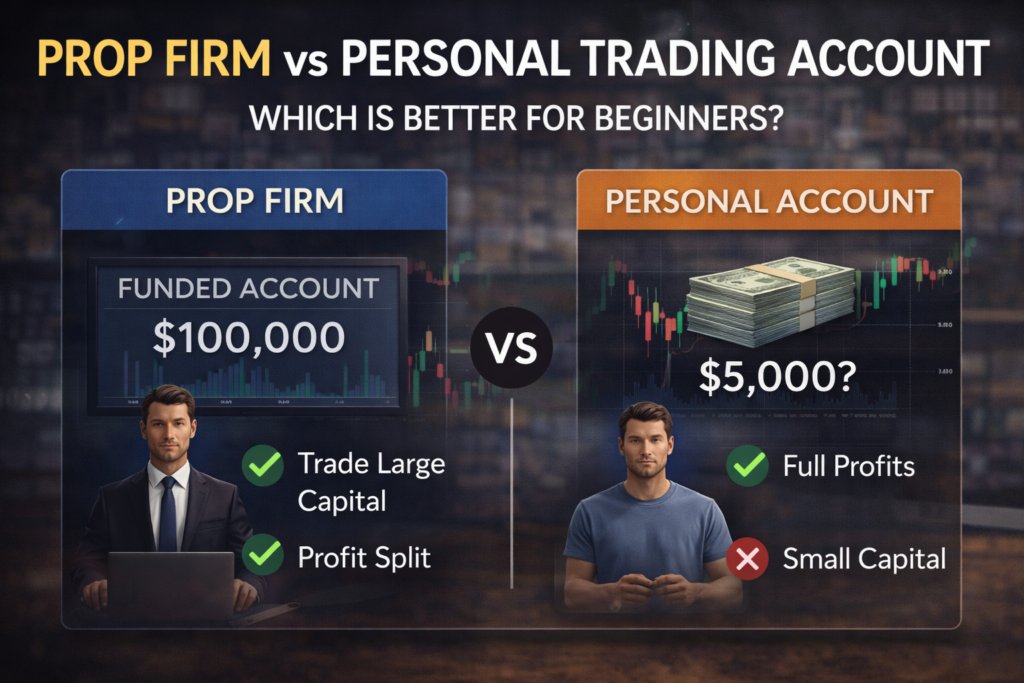
- Personal account = your money
- Prop firm = their money
But that’s not the real difference.
The real difference is this:
A personal account gives you freedom.
A prop firm gives you rules.
Freedom sounds great… until you realize most beginners don’t need freedom.
They need structure.
That’s why so many traders blow personal accounts fast, not because they’re unintelligent, but because the environment does not protect them from emotional decisions.
Option 1: Trading Your Own Money (Personal Account)
What’s good about it
A personal account gives you:
- full control
- no rule restrictions
- no evaluation profit targets
- no minimum trading days
- no “you violated one rule, account gone” situation
And for experienced traders, this is ideal.
But beginners aren’t usually losing because of restrictions.
Beginners lose because of behavior.
Unlike personal accounts, prop firms impose strict drawdown limits that reset daily.
The hidden danger for beginners
Most beginner personal accounts fail for one reason:
the account is too small and the trader tries to force results.
This is how it plays out:
- You deposit $200–$1,000
- You want results fast
- A 1% risk rule feels pointless because it produces “nothing”
- You size up to feel progress
- A few losses hit
- You get emotional
- You revenge trade
- It’s over
Most blown personal accounts don’t come from bad strategies.
They come from allowing one trade to matter too much.
If you want the deeper explanation behind this behavior, read:
Why Most Forex Traders Blow Their First Account (And It’s Not Because of Strategy)
Option 2: Trading With a Prop Firm
If you’re new, the appeal is obvious:
Instead of risking $10,000 of your own capital, you pay a smaller fee and attempt to qualify for a funded account.
But beginners misunderstand what prop firms actually are.
A prop firm is not a charity.
It is a structured evaluation business designed to filter out traders who cannot control risk under pressure.
So yes, prop firms can be a great tool.
But only if you understand what you’re walking into.
If you haven’t read it yet, start here:
What Is a Prop Firm? (And Why Most Traders Fail the Challenge)
What’s good about a prop firm for beginners
A prop firm forces structure.
It forces you to respect:
- daily loss limits
- maximum drawdown
- consistency behavior
- rule discipline
And this structure can protect beginners from their biggest weakness:
overtrading and oversizing.
Many traders experience their best discipline ever during a prop firm evaluation, because survival becomes the priority.
Ironically, that is when they trade the best.
The hidden danger (what nobody tells beginners)
Prop firms also introduce a different kind of pressure:
performance pressure.
Because now you’re thinking:
- “I paid for this”
- “I need to pass”
- “I can’t waste time”
- “I should take more trades”
- “I can pass in 2–3 big wins”
That mindset is exactly what fails most challenges.
Prop firms don’t expose lack of strategy.
They expose lack of emotional control.
That’s why this article exists:
Why Most Traders Fail Prop Firm Challenges (It’s Not Because of Strategy)
So Which One Is Better for Beginners?
Here’s the honest answer:
A prop firm is better for beginners who…
✅ need structure
✅ struggle with discipline
✅ overtrade or revenge trade
✅ have a small personal account
✅ want a framework that forces risk control
If you’re the kind of beginner who gets emotional after a loss, a prop firm evaluation can actually teach you professional behavior faster than a personal account, because the rules punish mistakes immediately.
A personal account is better for beginners who…
✅ are patient
✅ can risk small consistently
✅ can treat trading like a long-term skill
✅ are not emotionally reactive
✅ are not trying to “make money fast”
If you can truly trade a personal account at low risk, survive drawdowns, and stay consistent, you’re already ahead of most retail traders.
The Biggest Beginner Mistake (This Is What Ruins Both)
The number one beginner mistake is not choosing the wrong option.
It’s bringing the wrong mindset into either option.
Beginners try to force results
They try to turn trading into income immediately.
That pressure creates:
- oversizing
- impatience
- revenge trading
- session violations
- chasing entries
- “one big trade” thinking
This destroys personal accounts.
And it destroys prop firm evaluations.
A Simple Rule That Makes This Easy
If you don’t know which path to choose, use this rule:
If your personal account is under $5,000…
you are likely going to feel pressure to size up.
And if you feel pressure to size up, you are not trading.
You are forcing.
A prop firm may be better simply because it forces you to trade small enough to survive.
But only if you approach it correctly.
What I Recommend for Most Beginners
This is the most realistic progression for beginners:
Step 1 — Learn risk and discipline first
Before you pay for anything, understand:
- position sizing
- drawdown
- how to survive losing streaks
Read this:
What Is Risk Management in Forex (The Only Skill That Actually Matters)
Step 2 — Prove you can follow rules on demo
Most people skip this because it feels slow.
But if you can’t follow risk rules on demo, you won’t follow them with money.
Step 3 — Start a small prop firm challenge as training
Not because you’re trying to get rich.
Because you’re learning how to follow rules under pressure.
Final Thoughts
A prop firm is not a shortcut.
And a personal account is not automatically safer.
The right choice depends on one thing:
Can you control your behavior under uncertainty?
Because trading is not a prediction profession.
It is a decision-making profession under pressure.
And the trader who survives long enough to improve is the trader who eventually wins.
Transparency & Disclosure
TraderDecisions is an educational website.
We do not sell signals, trading systems, or financial advice.
Trading involves significant risk and most retail traders lose money. The purpose of this website is to help traders understand rules, risk, and realistic expectations before risking capital.
Some links on this site may be affiliate links, which means we may earn a commission at no extra cost to you. This does not influence our reviews, tools and firms are discussed based on trader usability and beginner safety.
About the Author
Orbin Johnson is an active forex trader focused on risk management, funded accounts, and beginner trader education. His work centers on helping new traders avoid common early mistakes before risking real capital.
Start here if you’re new:
What Is a Prop Firm? (And Why Most Traders Fail the Challenge)
Also read:
Why Most Forex Traders Blow Their First Account (And It’s Not Because of Strategy)