Many new traders are first attracted to forex trading because of one word:
leverage.
They hear:
“You can control a large account with a small amount of money.”
And that sounds like opportunity.
In reality, leverage is not what makes trading easier.
Leverage is what makes trading dangerous.
Most beginners do not lose their first account because they chose the wrong strategy.
They lose it because they did not understand leverage.
What Leverage Actually Means
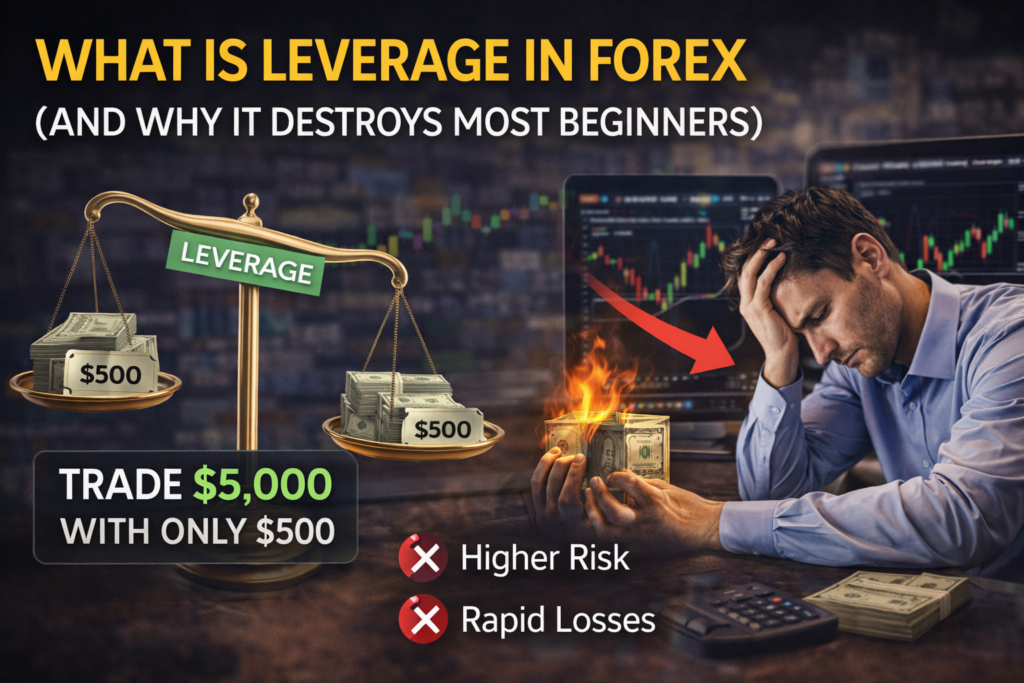
Leverage allows a trader to control a larger position than the money they personally deposit.
For example:
If a broker offers 1:100 leverage, a trader who deposits $100 can open a position worth $10,000.
Nothing about the chart changed.
Nothing about the market changed.
Only one thing changed:
how sensitive the account is to price movement.
And this is where beginners misunderstand trading.
They think leverage increases profit.
Leverage actually increases consequences.
The Illusion It Creates
At first, leverage feels helpful.
A small price move creates noticeable profit.
A 10-pip move suddenly matters.
The trader feels they finally “found something that works.”
But the same mechanism works in reverse.
A small move against the trade now matters just as much.
And forex markets move both directions constantly.
The trader is not trading a bigger opportunity.
They are trading a smaller margin for error.
Why Beginners Use Too Much
New traders are usually not trying to gamble.
They are trying to make trading “worth it.”
If a $200 account only makes $2 on a trade, it feels insignificant.
So they increase position size.
They believe they are improving the trade.
In reality, they are shrinking the number of mistakes they are allowed to make.
This is why accounts often blow up quickly, not slowly.
The trader was never wrong many times.
They were wrong once while overexposed.
What Actually Happens in a Leveraged Trade
Here is the part that is rarely explained clearly.
A normal market fluctuation, not a bad trade, can close an account.
Forex pairs regularly fluctuate 20–50 pips during normal movement.
With proper position sizing:
that fluctuation is manageable.
With excessive leverage:
that fluctuation becomes account-ending.
The trader believes:
“My strategy failed.”
But the strategy never had the chance to work.
The position size was too sensitive to normal price movement.
Why Prop Firms Care About This
Many traders are confused by prop firm rules such as:
• daily loss limits
• maximum drawdown
• lot size discipline
These rules are not arbitrary.
They exist to control leverage behavior.
A trader who over-leverages cannot survive long enough to be consistent.
Prop firms are not testing prediction.
They are testing whether the trader understands risk exposure.
This is also why many traders pass evaluations and then lose the funded account; their position size quietly increases once pressure to earn begins.
(If you are unfamiliar with how funded trading works, read: What Is a Prop Firm?)
The Real Purpose of Leverage
Leverage was not created to help beginners grow small accounts quickly.
It exists to allow professionals to:
• allocate capital efficiently
• reduce idle cash
• manage large portfolios
Professional traders rarely use maximum leverage.
Beginners almost always do.
And that single difference explains many early failures in trading.
The Practical Rule Most Traders Learn Too Late
The safest way to view leverage is this:
Leverage should make trading possible, not meaningful.
Your profit should come from consistency, not exposure.
If one trade can significantly damage your account, the position size is too large.
A trader does not fail because they used leverage.
They fail because they depended on it.
Conclusion
Leverage is not an advantage.
It is a responsibility.
It does not make a trader better or worse.
It only makes mistakes matter more.
Forex trading becomes manageable when a trader accepts a simple idea:
The goal is not to maximize profit per trade.
The goal is to survive long enough to improve.
Because in trading, longevity creates consistency, and leverage, when misunderstood, removes longevity.
Transparency & Disclosure
This article is for educational purposes only and does not constitute financial or investment advice. Trading involves risk and is not suitable for all individuals.
About the Author
Orbin Johnson is an active forex trader focused on risk management, funded accounts, and beginner trader education. His work centers on helping new traders understand trading behavior and avoid early account failures.