Many traders entering the prop firm world wonder if they can simplify the process by copying trades instead of executing their own strategies.
Copy trading has become extremely popular in the retail trading space, allowing traders to automatically mirror trades from other accounts or signal providers.
But when it comes to prop firm challenges and funded accounts, the rules around copy trading can be very different.
Understanding whether copy trading is allowed — and how prop firms detect it — is critical before attempting it.
What Is Copy Trading?
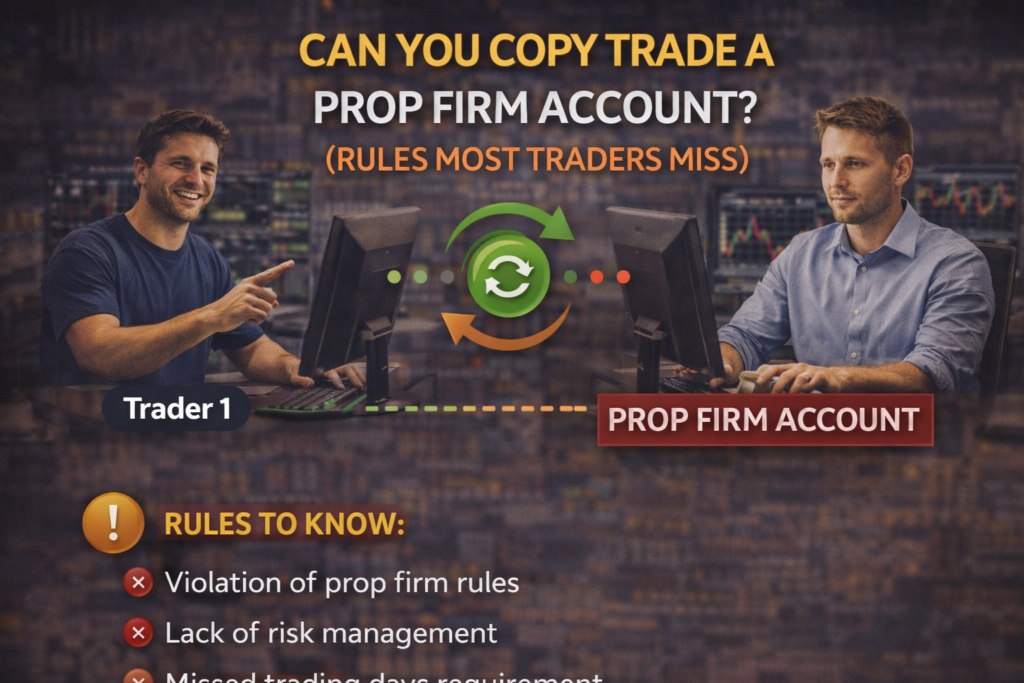
Copy trading is a system where trades from one account are automatically replicated in another account.
This can be done using:
• signal services
• trade copier software
• automated trading tools
• account mirroring systems
In theory, copy trading allows a trader to follow a more experienced trader’s strategy without making manual decisions.
However, prop firms view this practice very differently.
Do Prop Firms Allow Copy Trading?
Most prop firms do not allow traders to copy trades from external accounts or signal providers.
This is because the purpose of a prop firm challenge is to evaluate the trader’s own trading ability and risk management.
Allowing traders to simply copy another trader would defeat the purpose of the evaluation.
Many prop firms explicitly prohibit:
• copying trades from other traders
• sharing signals between multiple accounts
• using group trade copier services
• mirroring trades across accounts
Violating these rules can result in challenge failure or funded account termination.
Can You Copy Trade Your Own Accounts?
Some prop firms allow traders to copy trades between their own accounts, but only under specific conditions.
For example, a trader may copy trades between:
• two personal accounts
• multiple prop firm accounts owned by the same trader
However, even this practice can trigger risk monitoring systems.
Prop firms use algorithms that analyze:
• identical trade timing
• identical lot sizes
• identical entries and exits
If accounts appear to be copying trades from outside sources, they may be flagged for review.
Why Prop Firms Restrict Copy Trading
Prop firms restrict copy trading for several important reasons.
Fairness
If traders could simply copy successful signal providers, the challenge would no longer measure the trader’s own skill.
Risk Control
Prop firms want to ensure traders understand:
• position sizing
• risk management
• drawdown limits
You can read more about these rules here:
➡ Prop Firm Drawdown Rules Explained
Consistency
Successful funded traders demonstrate consistent decision-making.
Many firms also monitor trading consistency to detect abnormal behavior.
➡ Why Prop Firms Have Consistency Rules
The Safer Alternative to Copy Trading
Instead of copying trades directly, traders should focus on developing a structured trading approach.
This includes:
• controlled risk per trade
• patience in waiting for setups
• disciplined trading behavior
Many traders fail challenges simply because they try to shortcut the process.
➡ Why Most Traders Fail Prop Firm Challenges
How Most Traders Actually Pass Challenges
Successful traders typically rely on a simple process:
- Risk small amounts per trade
- Avoid overtrading
- Focus on high-probability setups
- Protect the account drawdown
Passing a prop firm challenge often takes time and patience.
➡ How Long It Actually Takes to Pass a Prop Firm Challenge
Final Thoughts
While copy trading may seem like a shortcut to passing prop firm challenges, most prop firms either restrict or carefully monitor this behavior.
Traders who attempt to bypass the evaluation process through trade copying risk losing both their challenge and potential funded accounts.
The most reliable path to becoming a funded trader is developing a disciplined strategy, respecting risk rules, and trading consistently over time.