If you’re trying to pass a prop firm challenge, this is the guide you should read first.
Most traders fail prop firm challenges not because they lack a strategy, but because they do not fully understand how the evaluation process actually works.
In this complete beginner guide, you’ll learn:
- what a prop firm challenge is
- how the evaluation and verification phases work
- what profit targets and drawdown rules really mean
- what happens after you pass
- why most traders fail before getting funded
By the end of this guide, you’ll understand exactly how prop firm challenges work and what it takes to approach them with the right mindset.
What You’ll Learn in This Guide
In this article, we’ll cover:
- What a prop firm challenge is
- How the evaluation phase works
- What verification means
- Profit targets and risk rules
- Maximum drawdown and daily loss limits
- What happens after you pass
- Why most traders fail prop firm challenges
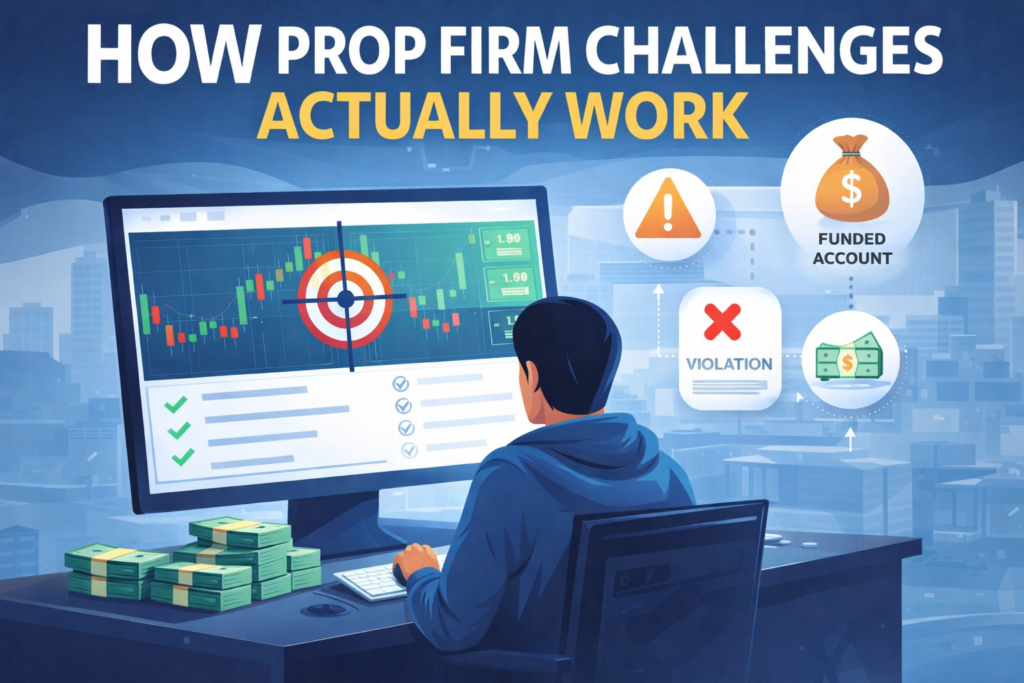
What a Prop Firm Challenge Is
A prop firm challenge is an evaluation process used by proprietary trading firms to identify profitable traders. Instead of giving traders immediate access to company capital, firms require them to pass a simulated trading challenge first.
During this challenge, traders must follow specific rules while attempting to reach a profit target. If they succeed without violating any of the risk limits, they earn the opportunity to manage a funded trading account.
The goal of the challenge is simple: prove that you can trade responsibly while managing risk.
Most prop firms want to see traders demonstrate three core qualities:
• Consistent profitability
• Strong risk management
• Emotional discipline
IIf you’re completely new to this topic, start here first:
👉 What Is a Prop Firm Challenge
That guide breaks down the fundamentals and is the best starting point if you’re still learning the basic terminology.
The Evaluation Phase
Most prop firms structure their challenges in two phases.
These phases are designed to confirm that traders are profitable and consistent before receiving a funded account.
Phase 1: Evaluation
In the first phase, traders must reach a profit target while following strict risk rules. This phase is typically the most difficult part of the challenge.
Common requirements include:
• Profit target of 8–10%
• Maximum drawdown limits
• Daily loss limits
• Minimum trading days
This phase is meant to test your ability to grow an account while protecting capital.
Phase 2: Verification
After completing the first phase, traders move to the verification stage. This phase confirms that the trader’s performance was not the result of luck or a single large trade.
Verification usually has:
• Lower profit targets (often around 5%)
• The same risk rules as phase one
• Minimum trading days
Once this phase is completed successfully, the trader is typically awarded a funded account.
Why Understanding the Structure Matters
Many traders jump into prop firm challenges too quickly.
They focus on the profit target, but ignore the real reason most traders fail:
- misunderstanding drawdown rules
- underestimating daily loss limits
- rushing the process
- trading too aggressively under pressure
The traders who pass usually are not the fastest traders. They are the ones who understand the structure, respect the rules, and manage risk from the beginning.
Profit Target Rules
Profit targets are one of the most important requirements of any prop firm challenge.
Most firms require traders to reach a profit target of around 8–10% during the first evaluation phase. For example, if you are trading a $100,000 challenge account, you may need to generate $8,000 to $10,000 in profit.
At first glance, this might sound easy. However, the challenge becomes difficult when combined with the strict risk limits imposed by the firm.
Because of these restrictions, traders must balance profitability with careful risk management. Aggressive trading strategies often lead to account violations before the profit target is reached.
The most successful traders approach the challenge with a slow and consistent strategy rather than trying to reach the target as quickly as possible.
Maximum Drawdown Rules
Drawdown rules are the most common reason traders fail prop firm challenges.
A drawdown rule limits how much money a trader can lose before the account is terminated.
Most firms enforce two types of drawdown:
• Maximum account drawdown
• Daily loss limits
Maximum drawdown refers to the total amount the account can decline before failing the challenge.
For example, a $100,000 challenge might allow a maximum drawdown of $10,000. If the account balance falls below $90,000 at any point, the challenge is automatically failed.
To fully understand this rule, read our detailed explanation here:
Prop Firm Drawdown Explained
Understanding drawdown rules alone can dramatically increase your chances of passing a challenge.
Daily Loss Limits
In addition to maximum drawdown, most prop firms also enforce daily loss limits.
A daily loss limit restricts how much money a trader can lose in a single day. If that limit is exceeded, the challenge account is terminated immediately.
For example, a firm may impose a daily loss limit of 5%. On a $100,000 account, that would mean the trader cannot lose more than $5,000 in a single day.
Daily loss rules are designed to prevent reckless trading and protect the firm’s capital.
Traders who ignore these limits or attempt revenge trading after losses often violate the rules quickly.
Successful traders treat the daily loss rule as a hard stop and reduce their risk exposure when approaching it.
Consistency Rules
Some prop firms require traders to maintain consistent performance rather than relying on a single large winning trade.
This rule is often called a consistency rule.
For example, a firm might limit how much of your total profit can come from a single trading day. If one day produces too large a portion of the total profit target, the trader may be required to continue trading until the profits become more evenly distributed.
The goal of consistency rules is to ensure traders are demonstrating repeatable skill rather than gambling on one lucky trade.
To understand how this works in more detail, read:
Consistency Rules
Minimum Trading Days
Most prop firm challenges also include a minimum number of trading days.
This requirement ensures that traders cannot pass the challenge by opening a single large trade and hitting the profit target immediately.
Typical minimum trading day requirements range from 5 to 10 days.
This rule encourages traders to demonstrate consistent performance across multiple trading sessions.
If you’re curious about the typical timeline traders need to complete a challenge, see our guide:
How Long to Pass a Prop Firm Challenge
How to Choose the Right Prop Firm Challenge
Not all prop firm challenges are structured the same way.
Some are easier to manage because they offer:
- lower profit targets
- simpler drawdown rules
- more flexible time limits
- fewer consistency restrictions
If you’re trying to compare actual firms and challenge models, read:
👉 Best Prop Firms for Beginners (2026 Honest Comparison)
If you want to understand which challenge structures tend to feel easier for beginners, read:
👉 Easiest Prop Firm Challenge to Pass (Ranked for Beginners)
What Happens After You Pass
After successfully completing the evaluation and verification phases, traders receive a funded account.
A funded account allows traders to manage the firm’s capital while sharing a portion of the profits.
Most prop firms offer profit splits between 80% and 90%, meaning traders keep the majority of the profits they generate.
For example, if a trader makes $10,000 in profit and the firm offers a 90% split, the trader keeps $9,000 while the firm receives $1,000.
Payout schedules vary depending on the firm, but most allow withdrawals every two to four weeks.
If you’re wondering whether these firms truly pay their traders, read:
Do Prop Firms Actually Pay Traders
Why Most Traders Fail Prop Firm Challenges
Although prop firm challenges offer a real opportunity to access capital, most traders still fail the evaluation process.
In most cases, the reason is not strategy alone.
Most traders fail because they do one or more of the following:
trade emotionally instead of following a plan
risk too much too early
ignore the daily loss limit
overtrade after a losing streak
chase the profit target too fast
Common causes of failure include:
• Over-leveraging positions
• Ignoring drawdown rules
• Emotional decision-making
• Revenge trading after losses
• Poor risk management
Many traders approach the challenge with unrealistic expectations, attempting to hit the profit target quickly rather than trading consistently.
If you want to understand the psychology behind this, read:
Why Traders Fail Prop Firm Challenges
Are Prop Firm Challenges Worth It?
For many traders, prop firm challenges represent one of the most accessible paths to trading large capital.
Instead of risking personal savings, traders can prove their skill through an evaluation process and earn access to accounts that may range from $50,000 to several hundred thousand dollars.
However, these challenges are not easy.
They require discipline, patience, and strict risk control. Traders who treat the challenge like a gambling opportunity usually fail quickly.
Those who approach it like a professional trading career have a much better chance of success.
Related Guides
If you want to understand prop firm challenges more deeply, these articles will help:
- 👉 What Is a Prop Firm Challenge
- 👉 Best Prop Firms for Beginners (2026 Honest Comparison)
- 👉 Easiest Prop Firm Challenge to Pass (Ranked for Beginners)
- 👉 Prop Firm Drawdown Explained
- 👉 How Long It Actually Takes to Pass a Prop Firm Challenge
- 👉 Why Most Traders Fail Prop Firm Challenges
- 👉 Do Prop Firms Actually Pay Traders?
Final Thoughts
Prop firm challenges have changed the trading landscape by giving independent traders access to professional-level capital.
But success requires far more than simply reaching a profit target. Traders must understand drawdown rules, risk management, and the psychological challenges that come with trading under strict guidelines.
The traders who succeed are not necessarily the ones with the best strategy. They are the ones who manage risk, stay disciplined, and make smart decisions under pressure.
If you are considering a prop firm challenge, do not rush into one blindly.
Take the time to understand the rules, the evaluation structure, and the risk limits before you ever place a trade.
That alone can dramatically improve your chances of passing and eventually earning a funded account.