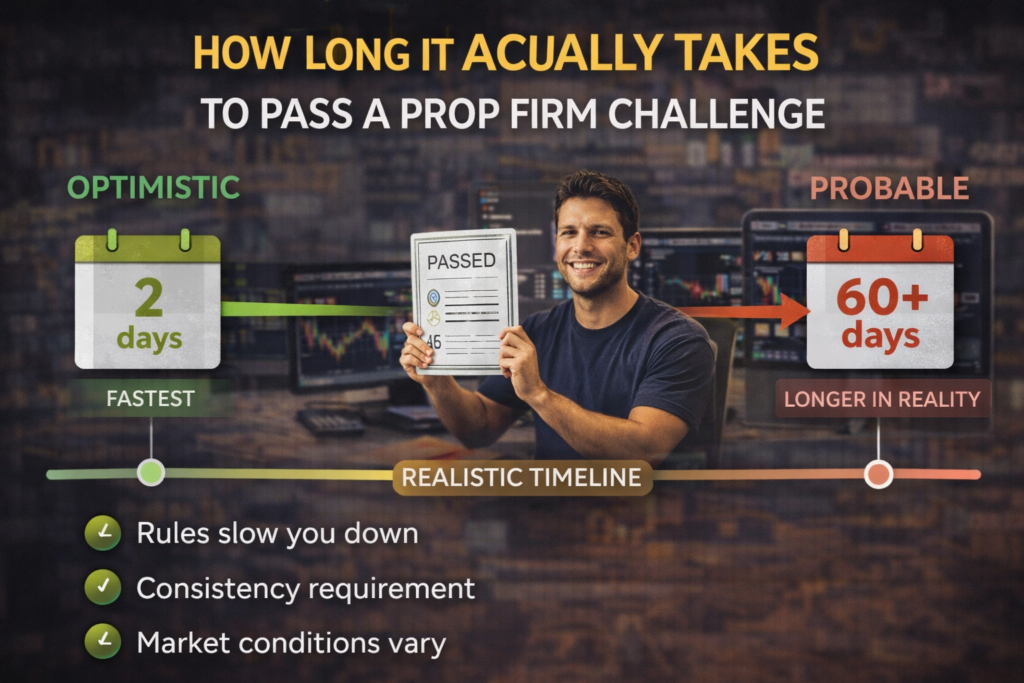
Most new traders believe passing a prop firm challenge should be fast.
They see screenshots online:
- “Passed in 5 days”
- “Funded in one week”
- “$200K account secured!”
So naturally, they think:
“If I study hard, I should pass my challenge in 2–3 weeks.”
Unfortunately, that expectation is one of the biggest reasons traders fail, not because of strategy… but because of time pressure.
This article will explain the real timeline, what prop firms actually expect, and why rushing is the main reason most traders never get funded.
The Truth Most Traders Don’t Understand
A prop firm challenge is not designed to see how fast you can make money.
It is designed to see how consistently you can avoid losing money.
That is a completely different skill.
A beginner trader focuses on:
• Finding entries
• Catching big trades
• Passing quickly
A funded trader focuses on:
• Risk control
• Drawdown protection
• Emotional stability
This is why many traders who are profitable on demo accounts still fail challenges repeatedly.
They are trading for speed, while the firm is testing for discipline.
How Prop Firm Drawdown Actually Works
Why Traders Try to Pass Too Fast
There is a psychological trap in prop firm challenges.
The trader has:
- Paid a fee
- Started a countdown clock
- Feels pressure to “make it worth it”
This creates urgency.
Urgency leads to:
- Overtrading
- Increasing lot sizes
- Revenge trading
- Ignoring rules
The trader stops trading a plan and starts trading the deadline.
The firm is watching for exactly this behavior.
Why Prop Firms Have Consistency Rules
What Prop Firms Are Actually Testing
Prop firms already know traders can win trades.
What they do NOT trust is whether a trader can survive months of normal market conditions without blowing up.
So they watch for three things:
1. Risk Management
Can you control losses?
Not avoid losses — control them.
2. Emotional Stability
Do you change your behavior after a losing day?
Most traders double risk after losses.
That immediately signals a future account failure.
3. Consistency
Are your trading results stable?
This is why many firms enforce consistency rules and daily loss limits.
They are trying to answer one question:
“If we give this trader real capital, will the account still exist in 60 days?”
The Realistic Timeline
Here is the reality most traders never hear.
Typical Beginner
3–12 months
Not because they cannot trade, but because they must first unlearn bad habits:
• Impatience
• Over-risking
• Needing constant trades
Developing Trader
2–6 months
At this stage they:
• Understand drawdown
• Accept small wins
• Follow a plan
They still fail challenges, but now for smaller reasons.
Disciplined Trader
1–3 months
Now the trader:
• Trades fewer setups
• Skips bad days
• Protects equity
This is the stage where funding usually happens.
Why Fast Passes Often Lead to Account Loss
Ironically, traders who pass very quickly often lose the funded account.
Why?
Because the speed usually came from:
• High risk
• Aggressive lot sizing
• Favorable market conditions
But once funded, they must repeat it, and markets change.
The prop firm understands this.
This is why they do not reward speed.
They reward survival behavior.
The Hidden Goal of a Prop Firm Challenge
The challenge is not really Phase 1 and Phase 2.
The real test is this:
Can you trade the same way for 30–60 days without violating rules?
A trader who slowly reaches profit targets while respecting daily loss limits shows something rare:
Control.
That is what firms fund.
Why Patience Is the Edge
Many traders blow accounts because they believe:
“I need to make money every day.”
You don’t.
Professional traders often:
• Skip entire weeks
• Take only a few trades
• Protect capital above profit
In fact, the trader who trades less often passes more often.
The challenge rewards restraint, not activity.
A Healthy Way to Approach a Challenge
Instead of asking:
“How fast can I pass?”
Ask:
“Can I trade correctly for 60 days?”
That one mindset shift changes everything.
Your goal becomes:
• No rule violations
• Small steady growth
• Consistent behavior
Ironically, when traders stop trying to pass, they finally do.
Final Thoughts
Passing a prop firm challenge is not a race.
It is a behavioral filter.
Prop firms are not selecting the smartest traders.
They are selecting the most stable traders.
If you treat the challenge like a sprint, you will almost always fail.
If you treat it like a long-term trading job, your chances improve dramatically.
The traders who eventually get funded are rarely the ones who rush.
They are the ones who slow down, respect risk, and prove they can keep an account alive.
And in the eyes of a prop firm, survival matters more than profit.