Most traders believe passing a prop firm challenge depends on strategy, finding the right setup, the right entry, or the right indicator.
In reality, most traders who fail do not fail because their analysis is wrong. They fail because they misunderstand what the evaluation is actually measuring.
Prop firms are not primarily testing prediction ability.
They are testing whether a trader can control risk and behavior under pressure.
What Traders THINK the Test Is
Most beginners approach a prop firm challenge believing success comes from:
- finding a good setup
- perfect entries
- better indicators
- one large winning trade
What the Firm Is ACTUALLY Testing
The evaluation rules reveal the real objective:
- daily loss limits
- maximum drawdown
- minimum trading days
- consistent trading behavior
Prop firms are not testing strategy.
They are testing emotional control and risk behavior.
My Personal Experience
When I first started trading, I thought success came from finding the perfect setup. I rushed trades, increased position size after losses, and tried to win money back quickly by entering in the middle of moves. Looking back, I wasn’t really trading; I was reacting emotionally.
It took time, several lessons, and several failed evaluations and real trading losses before I understood something important: consistency does not come from predicting price. It comes from controlling risk.
Why Drawdown Rules Exist
In professional trading, protecting capital is more important than making profit. A firm can work with a trader who grows slowly and safely, but it cannot work with a trader who produces unpredictable equity swings. Drawdown rules exist to identify traders whose behavior remains stable regardless of winning or losing trades.
Many traders believe drawdown rules exist to make them fail. That is not actually their purpose.
Prop firms use daily loss limits, maximum drawdown, and minimum trading days because they are simulating real fund management. A firm cannot allow a trader to have one lucky day and then take excessive risk the next.
They are not looking for traders who occasionally win big trades.
They are looking for traders who protect capital consistently.
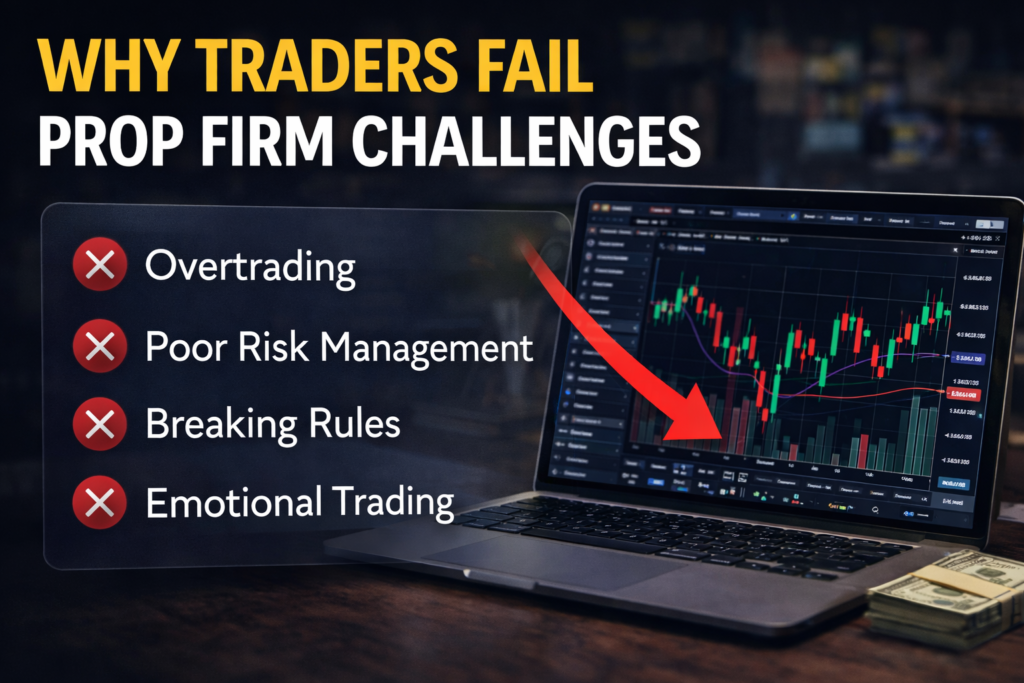
Many traders fail not because of bad strategy, but because they misunderstand daily loss limits and maximum drawdown rules.
Why Most Traders Violate the Rules
Most violations do not happen because traders forget the rules. They happen because psychology changes during the evaluation.
After a losing trade, traders increase size to recover faster.
After a winning trade, traders feel confident and take lower-quality setups.
The challenge exposes behavior patterns, impatience, revenge trading, and over-confidence — not trading knowledge.
The Real Skill
Trading is not a prediction profession.
It is a decision-making profession under uncertainty.
A trader does not pass a prop firm challenge by being right more often.
A trader passes by losing correctly.
The traders who succeed are not the traders with the best strategy.
They are the traders who protect capital consistently.
Recommended reading:
- What Is a Prop Firm? (And Why Most Traders Fail the Challenge)
- Why Most Forex Traders Blow Their First Account
This article is for educational purposes only and does not provide financial or investment advice.