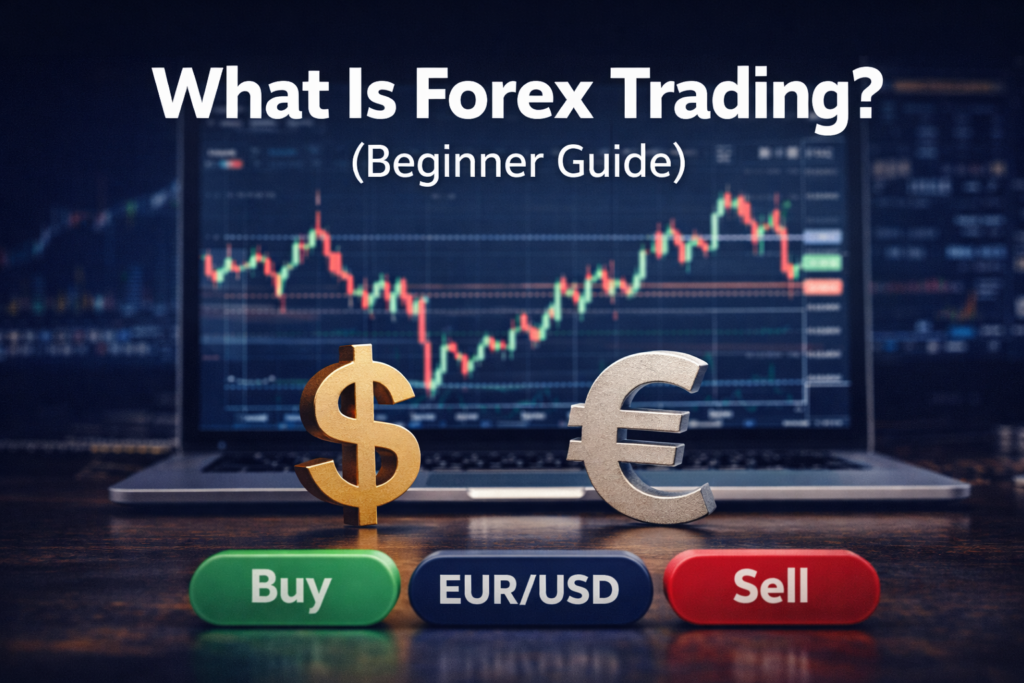
The foreign exchange market, commonly called forex or FX, is a global marketplace where currencies are traded.
Unlike stock markets, forex does not operate through a centralized exchange. Instead, trading takes place electronically between banks, financial institutions, hedge funds, companies, and individual traders around the world.
The forex market operates 24 hours a day during the week, moving through major trading sessions:
• Asian Session
• London Session
• New York Session
Because currencies are constantly exchanged for international trade, tourism, and investment, the forex market remains active nearly around the clock.
This constant activity is what creates the price movements traders attempt to profit from.
Currency Pairs Explained
Currencies in the forex market are always traded in pairs.
This means traders are simultaneously buying one currency while selling another.
For example:
EUR/USD
This pair represents the value of the euro compared to the U.S. dollar.
If EUR/USD rises, the euro is strengthening relative to the dollar.
If EUR/USD falls, the dollar is strengthening relative to the euro.
Currency pairs are typically grouped into three categories:
Major Pairs
These involve the U.S. dollar and the world’s largest economies.
Examples include:
• EUR/USD
• GBP/USD
• USD/JPY
Minor Pairs
These pairs do not include the U.S. dollar but still involve major global currencies.
Examples include:
• EUR/GBP
• AUD/NZD
Exotic Pairs
These involve smaller or emerging market currencies.
Examples include:
• USD/TRY
• USD/ZAR
Most beginners start by trading major pairs because they typically have the highest liquidity and lowest trading costs.
How Traders Make Money
Forex traders attempt to profit from changes in currency prices.
A trader can take two types of positions:
Buy (Long)
If a trader believes a currency pair will increase in value, they buy it.
Sell (Short)
If a trader believes the pair will fall, they sell it.
For example:
A trader buys EUR/USD at 1.1000 and sells at 1.1050.
The difference between those prices represents the trader’s profit.
However, most forex trading is done using leverage, which allows traders to control larger positions with smaller amounts of capital.
Leverage can significantly increase profits — but it can also magnify losses.
If you’re unfamiliar with leverage, read our guide:
👉 What Is Leverage in Forex Trading?
Why Forex Is Risky
Forex trading carries substantial risk.
While many advertisements promote the idea of quick profits, the reality is that the majority of new traders lose money when they start.
Several factors contribute to the risk:
Leverage
Leverage allows traders to control large positions with small deposits, which increases both potential profits and losses.
Market Volatility
Currencies can move rapidly due to economic news, interest rate decisions, geopolitical events, and market sentiment.
Emotional Decision Making
Fear and greed often cause traders to abandon their strategies.
Lack of Education
Many beginners enter the market without fully understanding how it works.
This combination of leverage, volatility, and psychology makes forex trading far more difficult than it first appears.
If you want to understand this better, read:
👉 Why Forex Trading Is Harder Than It Looks
Why Most Beginners Lose
Statistics across many brokers show that a large percentage of retail traders lose money.
This is rarely due to a lack of intelligence. Instead, it usually comes down to a few common mistakes.
Overtrading
Many beginners trade too frequently and take setups that do not meet their strategy criteria.
Risking Too Much Per Trade
Large position sizes can quickly wipe out accounts during losing streaks.
Chasing Losses
Trying to recover losses quickly often leads to emotional trading.
Ignoring Risk Management
Without proper risk control, even a few losing trades can cause significant account damage.
Understanding these mistakes is critical for long-term survival in trading.
You can learn more about this here:
👉 Why Most Traders Blow Accounts
What Beginners Should Learn First
Before focusing on profits, new traders should focus on building a foundation of knowledge and discipline.
Important concepts include:
Risk Management
Understanding how much to risk per trade is one of the most important skills a trader can develop.
Market Structure
Learning how price moves and reacts to supply and demand.
Trading Psychology
Controlling emotions and maintaining discipline when markets move unexpectedly.
Position Sizing
Knowing how much capital should be allocated to each trade.
Many traders also attempt to trade with prop firm challenges, which allow traders to access larger capital if they pass evaluation rules.
However, these challenges have strict risk limits that beginners must understand before attempting them.
To learn more about capital requirements, read:
👉 How Much Money Do You Need to Trade Forex?
Final Thoughts
Forex trading offers the opportunity to participate in the largest financial market in the world. But success in trading rarely comes quickly.
The traders who last the longest are usually those who focus first on education, discipline, and risk management before attempting to grow their accounts.
Instead of chasing shortcuts, beginners should aim to understand how markets behave and develop consistent decision-making over time.
That foundation is what ultimately separates struggling traders from those who succeed long term.