Most new traders ask this question very early:
“How much money do I need to start trading?”
Almost every YouTube video or social media post gives the same answer:
“You can start with $50.”
“You only need $100.”
“You don’t need much capital.”
Technically, that answer is true.
Practically, it is one of the main reasons beginners fail.
The problem is not whether you can start with a small account.
The problem is whether you can trade properly with one.
The Real Issue Is Not Capital — It Is Risk
Trading is not about how much you can make on a winning trade.
Trading is about how much you lose when you are wrong.
Every trader, no matter how experienced, will have losing trades. A strategy can be excellent and still lose multiple trades in a row. That is normal market behavior.
The only way a trader survives long enough to improve is by controlling risk.
This is where small accounts quietly create a trap.
What Actually Happens With a Small Account
Imagine a trader opens a $100 account.
They quickly discover something:
If they risk only 1% per trade (which is proper risk management), they are risking $1 per trade.
Even if they trade correctly and make 5% in a week, they made $5.
Nothing feels like it is happening.
So the trader does what almost everyone eventually does:
They increase lot size.
They begin risking 5%… 10%… sometimes more without realizing it.
Now one losing trade matters too much.
Two losses create frustration.
Three losses trigger revenge trading.
The account does not fail because of strategy.
The account fails because the account size forces emotional decision-making.
Why Beginners Overtrade Small Accounts
Small accounts create psychological pressure, even if the trader does not recognize it.
The trader thinks:
“I need this to grow faster.”
This leads to:
• entering early
• trading too often
• ignoring sessions
• moving stop losses
• trying to recover losses quickly
None of this comes from a lack of intelligence.
It comes from unrealistic expectations placed on too little capital.
The Math Most People Never Explain
Professional traders rarely focus on how much they can make.
They focus on how much they can safely risk.
A trader risking 1% per trade:
• can lose 10 trades in a row and still continue
• can improve
• can learn
A trader risking 10% per trade:
• is only a few trades away from ending the account
The difference between traders who eventually succeed and traders who quit is not strategy.
It is survival time.
Small accounts shorten survival time.
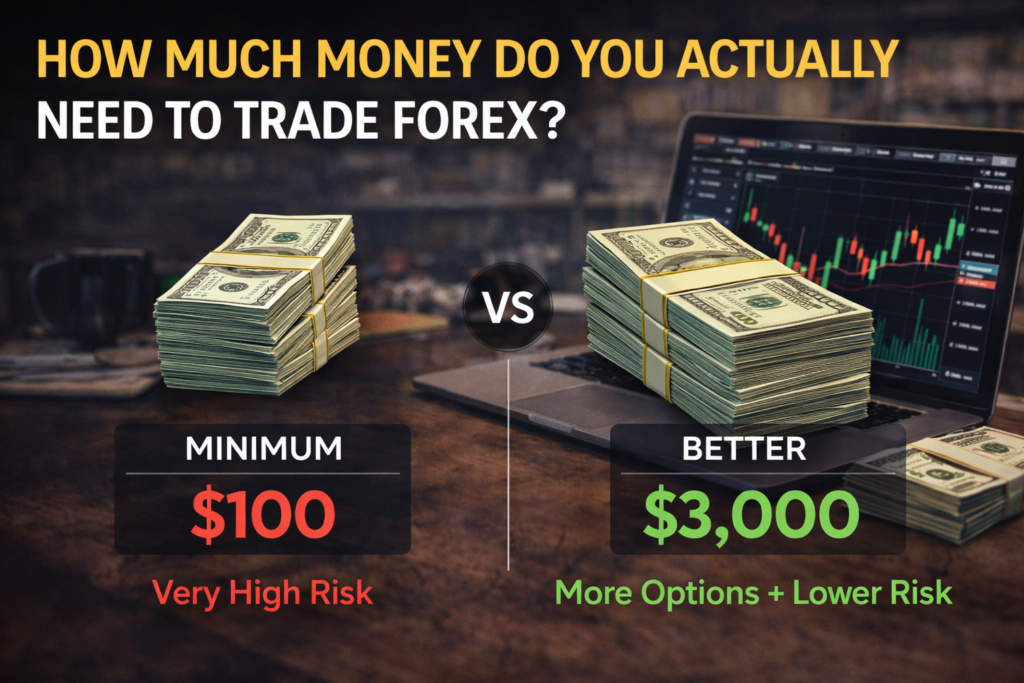
So How Much Do You Actually Need?
Here is the honest answer:
You need enough capital that you can follow proper risk management without feeling pressure to rush results.
For many beginners, that is not $100.
But that also does not mean you need to deposit thousands into a broker.
This is where many traders misunderstand their options.
Why Funded Accounts Became Popular
Proprietary trading firms (prop firms) exist for one specific reason:
They allow traders to practice structured risk management on a larger account size without risking large personal savings.
Instead of depositing $5,000–$10,000 of personal money, a trader pays an evaluation fee and must follow strict drawdown rules.
The goal is not just profit.
The goal is behavior.
The firm is testing whether the trader can manage risk consistently.
This is why so many traders who fail repeatedly on personal accounts actually improve once they approach trading with defined rules and limits.
(If you are not familiar with how these accounts work, you should read: What Is a Prop Firm?)
What Beginners Should Really Do
Before worrying about income, a trader should focus on three skills:
- position sizing
- patience
- emotional control
Trading income comes later.
Most traders fail because they try to skip the development stage and immediately treat trading as a salary.
Trading is a performance skill. It behaves more like learning a sport than starting a job.
You would not expect to play competitive tennis after two weeks of practice. Trading works the same way, but the internet rarely explains it honestly.
A Better Starting Approach
A healthier path looks like this:
• learn risk management first
• practice on demo
• trade small while learning discipline
• then consider structured funded evaluations
The goal early is not to make money.
The goal is to learn to not lose control.
Once a trader can follow rules consistently, the results begin to stabilize naturally.
Final Thoughts
You can start trading with a very small amount of money.
But most traders who do are unknowingly placing themselves in the hardest possible learning environment.
Trading success does not come from finding a perfect strategy.
It comes from managing risk long enough to gain experience.
The amount of money you need is not a fixed number.
It is simply enough capital, or enough structure, that allows you to trade patiently, follow rules, and stay in the game long enough to improve.
Because in trading, survival always comes before income.