What Is a Funded Trading Account?
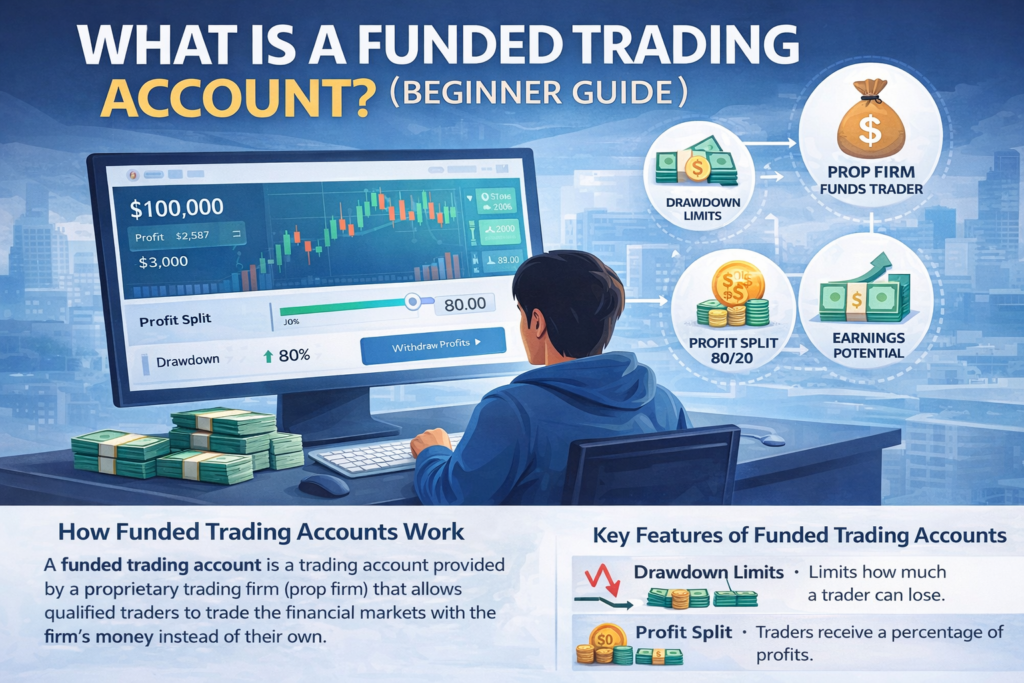
A funded trading account is a trading account provided by a proprietary trading firm (prop firm) that allows traders to trade with the firm’s capital instead of their own.
Instead of risking personal money, traders use firm capital and receive a percentage of the profits they generate.
Most traders access these accounts by first passing an evaluation process.
If you’re new to this process, start here:
➡ How Prop Firm Challenges Actually Work
How Funded Trading Accounts Work
Funded accounts follow a simple structure:
- You pass a prop firm evaluation
- You receive access to a funded account
- You trade under specific risk rules
- You keep a percentage of the profits
Unlike personal trading accounts, you are not trading freely without restrictions.
You are trading under a risk-managed system designed by the firm.
How Traders Get a Funded Account
To receive a funded account, traders must pass a prop firm challenge.
This evaluation is designed to test discipline, not just profitability.
Learn the full process here:
➡ What Is a Prop Firm Challenge
During the evaluation, traders must follow rules such as:
• Profit targets (usually 8–10%)
• Daily loss limits
• Maximum drawdown limits
• Minimum trading days
• Consistency rules
These rules ensure that traders can manage risk before being trusted with larger capital.
Key Rules in a Funded Trading Account
Once funded, the rules do not disappear.
They become even more important.
Maximum Drawdown
Drawdown is the maximum amount you can lose before the account is closed.
Full explanation here:
➡ Prop Firm Drawdown Explained
Most firms enforce:
• 5% daily loss limit
• 8–10% total drawdown
Breaking these rules results in immediate account failure.
Consistency Rules
Many prop firms require traders to show consistent performance.
This prevents traders from passing using one large trade.
Learn why this matters:
➡ Why Prop Firms Have Consistency Rules
Profit Targets (Evaluation Only)
Profit targets apply during the challenge phase.
Once funded, there is typically no profit target, only risk management rules.
Minimum Trading Days
Some firms require traders to trade for a set number of days to prove consistency.
How Much Money Can You Make?
Funded trading accounts offer strong earning potential.
Most prop firms offer profit splits between:
• 70% to 90% to the trader
For example:
If you make $5,000 profit on a funded account and your split is 80%:
You keep $4,000.
Do Prop Firms Actually Pay Traders?
This is one of the most common questions beginners ask.
The short answer is:
Yes, but only if you follow the rules.
Full breakdown here:
➡ Do Prop Firms Actually Pay Traders
Firms are not avoiding payouts.
They are enforcing risk control.
Most failed payouts happen because traders violate rules, not because firms refuse payment.
Why Funded Accounts Are Different From Personal Trading
A funded account is not the same as trading your own money.
Key differences:
Personal Account:
• No restrictions
• Unlimited risk
• Full control
Funded Account:
• Strict rules
• Controlled risk
• Profit sharing
The restrictions exist to protect the firm’s capital.
The Biggest Mistake Beginners Make
Most beginners fail funded accounts not because of strategy…
…but because of behavior.
Common mistakes:
• Overtrading
• Increasing lot size to pass faster
• Ignoring drawdown limits
• Emotional trading
If you want to understand this deeper:
➡ Why Traders Fail Prop Firm Challenges
How Long It Takes to Get Funded
Getting funded takes time.
Most disciplined traders take several weeks to pass a challenge.
Realistic breakdown here:
➡ How Long to Pass a Prop Firm Challenge
Trying to pass too quickly is one of the fastest ways to fail.
Is a Funded Trading Account Worth It?
For many traders, funded accounts provide a major advantage:
• Access to large capital
• Reduced personal risk
• Structured trading discipline
However, they require:
• patience
• discipline
• strict risk control
Without those, most traders fail repeatedly.
Final Thoughts
A funded trading account is not a shortcut to fast money.
It is a structured system designed to identify traders who can manage risk consistently.
The traders who succeed are not the ones who take the biggest trades.
They are the ones who:
• follow rules
• control risk
• trade consistently
Because in prop firm trading, consistency always beats intensity.