Many people discover forex trading the same way.
They see a chart moving.
They watch a video explaining a simple setup.
The trade works in the example.
It looks logical.
And the conclusion feels obvious:
“This doesn’t look that difficult.”
But once they begin trading themselves, the experience is completely different.
Forex trading is not difficult because charts are complicated.
Forex trading is difficult because decision-making under uncertainty is uncomfortable.
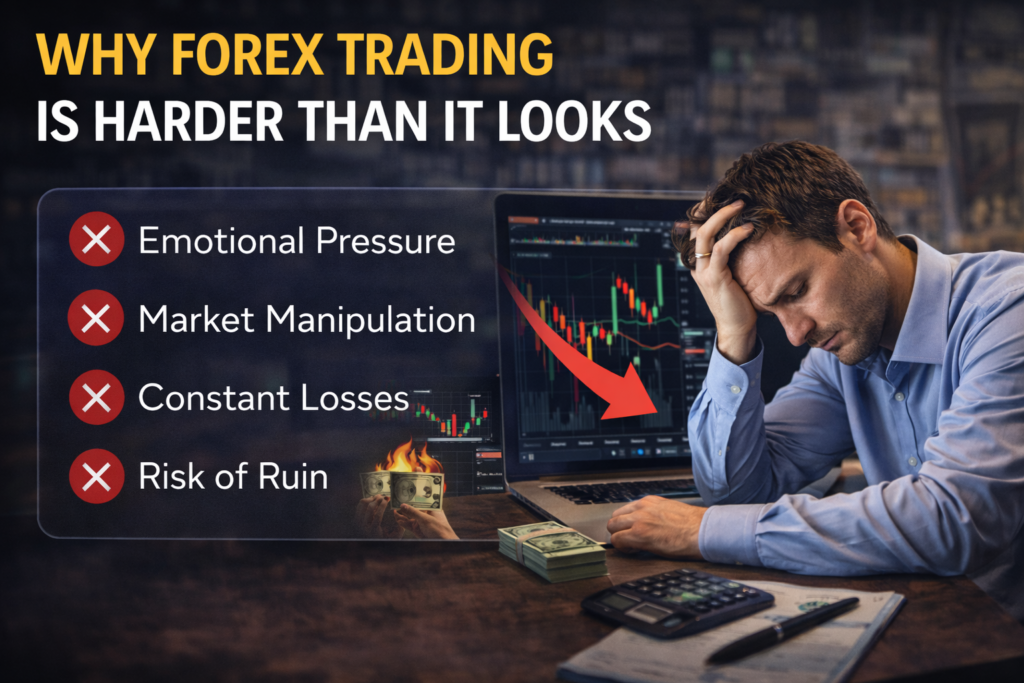
The Illusion of Simplicity
On the surface, trading looks straightforward.
Price moves up.
Price moves down.
You buy low and sell high.
Most educational videos also show clean examples:
a clear setup, a perfect entry, and a trade that moves quickly to profit.
But those examples hide the part that matters most:
uncertainty.
In live trading, you never know if a setup will work.
The market does not confirm your decision immediately.
Instead, it moves slightly against you, pauses, returns, and often tests your patience before doing anything clear.
This is where trading changes from analysis to psychology.
The Real Difficulty: Decision Pressure
Every trade forces a decision while money is at risk.
You must decide:
• Should I enter now or wait?
• Is this a real move or a fakeout?
• Should I close early or follow my plan?
• Should I re-enter after a loss?
Charts are not what makes trading hard.
Making decisions when you might be wrong is what makes trading hard.
Most beginners expect the challenge to be understanding the market.
The real challenge is managing themselves.
Why Beginners Struggle Early
When a new trader opens a chart, they focus on finding entries. They believe the solution is learning a better setup.
So they search for:
• indicators
• strategies
• confirmations
• signals
But the first problem in trading is not knowledge.
It is expectations.
Beginners unconsciously expect:
- quick improvement
- frequent winning trades
- steady income
The market does not behave that way.
Even good traders lose trades regularly.
Even strong setups fail.
Even correct decisions can have negative short-term outcomes.
Without realistic expectations, every normal trading experience feels like a mistake.
The Emotional Cycle
Most new traders go through the same sequence:
They win early → confidence increases
They lose → confusion starts
They change strategy → results worsen
They trade more → losses grow
They begin forcing trades → discipline disappears
This exact cycle is the reason many beginners lose their first trading account.
They believe the problem is the system.
Usually, the problem is pressure.
The trader is reacting to outcomes instead of following a process.
Why Practice Doesn’t Feel Like Real Trading
Many traders notice something strange:
They trade well on demo accounts, but poorly on live accounts.
This is not a skill difference.
It is a psychological difference.
On a demo account:
there is no consequence.
On a live account:
every decision feels important.
Losses feel personal.
Missed trades feel painful.
Waiting feels uncomfortable.
Trading performance changes not because the trader forgot what to do, but because the emotional environment changed.
What Trading Actually Rewards
Forex trading does not reward prediction.
It rewards behavior.
A trader does not succeed because they always know where price will go.
A trader succeeds because they:
• control risk
• accept losses
• wait for appropriate conditions
• repeat a process consistently
This is why risk management becomes more important than strategy for long-term survival
In other words, trading rewards patience and discipline more than intelligence.
Why This Matters Before Anything Else
Many traders rush into advanced topics like funded trading challenges or large position sizes.
But none of those matter if the foundation is missing.
Before focusing on profits, a trader must first become comfortable with uncertainty.
For traders completely new to funded trading, understanding how evaluations actually work is essential before attempting one.
Because the market will always be uncertain.
The goal is not to remove uncertainty.
The goal is to operate correctly even when it exists.
Forex trading is not harder than it looks because charts are complicated.
It is harder than it looks because it requires emotional stability in an environment where outcomes are never guaranteed.
And that is a skill learned slowly, not quickly.
Transparency & Disclosure
This article is for educational purposes only and does not constitute financial or investment advice. Trading involves risk and is not suitable for all individuals.
About the Author
Orbin Johnson is an active forex trader focused on risk management, funded accounts, and beginner trader education. His work centers on helping new traders understand trading behavior and avoid early account failures.