Over the past few years, many traders did not fail a prop firm challenge because of trading.
They failed because of the company they chose.
Rules changed.
Platforms disappeared.
U.S. traders were suddenly restricted.
Accounts were migrated.
Some firms simply stopped operating the way traders expected.
The trader followed their strategy correctly, and still lost the opportunity.
Most beginners think their first decision in trading is:
“What strategy should I learn?”
It isn’t.
Your first decision is:
Which company you are trusting with your time, effort, and evaluation fee.
A prop firm challenge is not just a trading test.
If you are new to funded trading, first understand how prop firm evaluations are structured before comparing companies.
It is a business agreement with a company you must rely on for rules, payouts, and platform stability. If the company is unstable, the trader carries risk that has nothing to do with trading skill.
What Most Beginners Don’t Realize
The evaluation fee looks small.
$50
$100
$300
But that is not the real cost.
The real cost is:
• weeks of trading
• emotional investment
• repeat attempts
A trader can follow every rule and still fail simply by choosing an unstable firm.
Many beginners spend months trying to “fix their strategy” when the real problem was never their trading behavior. It was the environment they were trading in.
What Actually Happened in the Prop Firm Industry
A lot of confusion exists because most traders entered the industry after it had already changed.
The Platform Instability
For years, many proprietary trading firms depended on MetaTrader platforms (MT4/MT5). When licensing restrictions and enforcement actions occurred, numerous firms suddenly lost access to their platform providers.
Firms had to:
• migrate traders
• change rules
• switch software
• or restrict access
This was not always the firm’s fault, but the trader still experienced the consequences.
An evaluation account requires consistency. A changing platform destroys consistency.
Even a disciplined trader can fail under unstable conditions.
Why U.S. Traders Were Affected
The United States has stricter financial regulations than many other regions. Instead of adapting to those requirements, several firms chose to stop accepting U.S. traders entirely.
From the trader’s perspective, it felt random.
You could pass a challenge, and suddenly your country was no longer eligible.
This created a situation where trading performance was no longer the only risk.
Company stability became a risk.
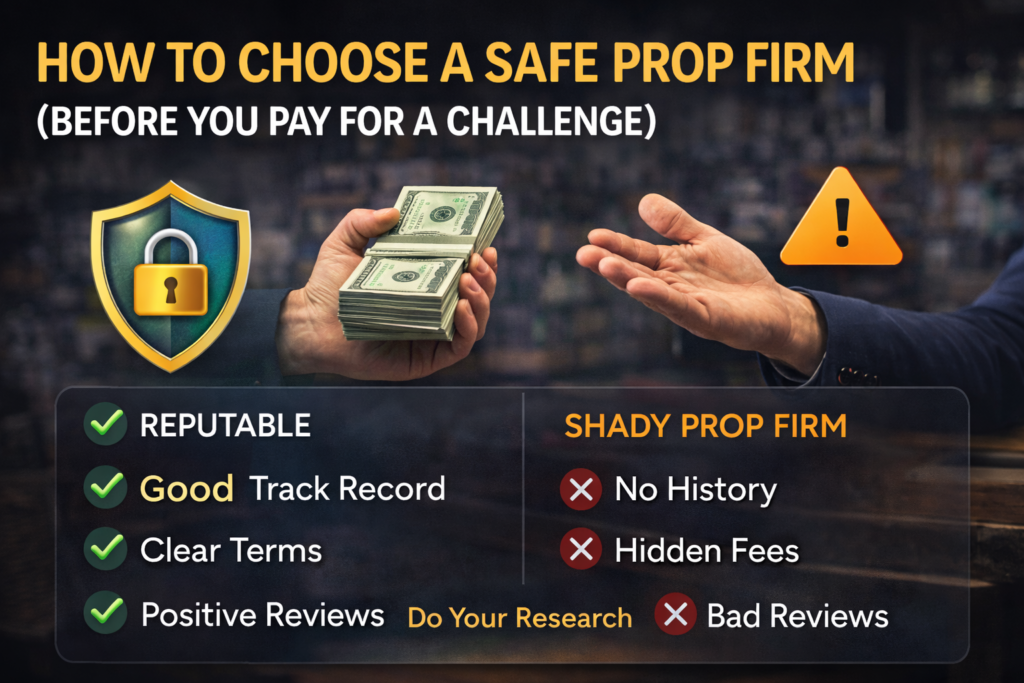
The 5 Things You Must Check Before Buying a Challenge
This is the part most beginners skip.
They compare discounts.
They should be comparing reliability.
1) Platform Stability
Before purchasing a challenge, ask:
Has this firm recently changed platforms?
Have traders been migrated multiple times?
A stable trading environment matters more than spreads or commissions. You cannot develop consistency on a constantly changing platform.
2) Verified Payout Behavior
Do not rely on social media screenshots.
Instead, look for:
• traders funded for months (not days)
• repeat payouts
• consistent payment timing
A good prop firm proves reliability through behavior, not marketing.
3) Rule Clarity
Many traders fail because they never fully understood the rules.
Most evaluation failures are behavioral mistakes, not technical ones.
Watch for:
• unclear consistency rules
• confusing trailing drawdown
• violations not explained clearly
If you cannot easily explain the rules to another person, you should not purchase the challenge yet.
4) Regional Stability
Especially for U.S. traders:
If a firm frequently changes which countries it accepts, you are assuming a risk unrelated to trading performance.
Your trading account should not depend on policy changes you cannot control.
5) Business Model Alignment
This is the most important concept beginners overlook.
A healthy prop firm wants traders to remain funded long-term.
An unhealthy prop firm earns most of its revenue from repeated challenge failures.
Stable firms:
• emphasize consistency
• have realistic risk limits
• support long-term trading
Unstable firms:
• rely heavily on promotions
• advertise extremely large accounts cheaply
• encourage fast passing behavior
A prop firm should benefit when you succeed, not when you repeatedly restart.
Examples of Currently Stable Firms
The following firms are not endorsements.
They are examples of companies that currently demonstrate operational stability, rule clarity, and consistent trader experiences based on long-term observation.
Established Stability
- Alpha Capital Group
- FTMO
Developing Track Record
• TopTier Trader (TX3 Funding)
This list may change over time. Traders should always evaluate a firm using the framework above rather than relying solely on recommendations.
The Biggest Beginner Mistake
Most beginners choose the cheapest challenge.
They should choose the most reliable company.
A $50 cheaper evaluation is not cheaper if you must repeat it five times.
Many traders blame themselves for failing when, in reality, they never gave themselves a fair environment to succeed.
Often, the issue begins long before the challenge, when expectations are unrealistic from the start.
Final Advice
Before purchasing a prop firm challenge:
Understand drawdown rules
Practice proper risk management on demo
Read the firm’s rules slowly and carefully
A prop firm should be treated as a long-term trading partner, not a lottery ticket.
Passing a challenge is not the first step in trading.
Some beginners may be better starting with a personal account before attempting funding.
Choosing the right firm is.
Transparency & Disclosure
TraderDecisions is an educational website.
We do not sell signals, trading systems, or financial advice.
Trading involves significant risk and most retail traders lose money. The purpose of this site is to help traders understand rules, risk, and realistic expectations before risking capital.
Some links on this site may be affiliate links, which means we may earn a commission at no extra cost to you. This does not influence our evaluations; companies are discussed based on trader usability, stability, and beginner safety.
About the Author
Orbin Johnson is an active forex trader focused on risk management, funded accounts, and beginner trader education. His work centers on helping new traders avoid early mistakes that commonly lead to repeated account failures.