Beginner Roadmap to Prop Firm Trading
If you’re just starting, follow this order:
1️⃣ What Is a Prop Firm Challenge
2️⃣ How Prop Firm Challenges Actually Work
3️⃣ Prop Firm Drawdown Rules Explained
4️⃣ Why Prop Firms Have Consistency Rules
5️⃣ How Long It Takes to Pass a Prop Firm Challenge
What Is a Prop Firm?
A proprietary trading firm (prop firm) is a company that allows traders to trade with the firm’s capital instead of their own money.
Instead of risking personal funds, traders go through an evaluation process. If they pass, they are given access to a funded account and earn a percentage of the profits they generate.
In simple terms:
👉 You are not being hired
👉 You are being tested
Prop firms are not looking for traders who can get lucky. They are looking for traders who can manage risk and protect capital consistently.
Because of this, beginners often rush into a prop firm evaluation before they understand what the challenge is actually testing.
Most assume the test is about predicting the market correctly.
It isn’t.
Prop firms are not primarily evaluating your strategy. They are evaluating your behavior, specifically your ability to control risk and follow rules under pressure. Traders who misunderstand this often repeat challenges multiple times, believing their strategy is the problem when the real issue is discipline.
Understanding how prop firms actually work can save a new trader significant frustration, time, and money.
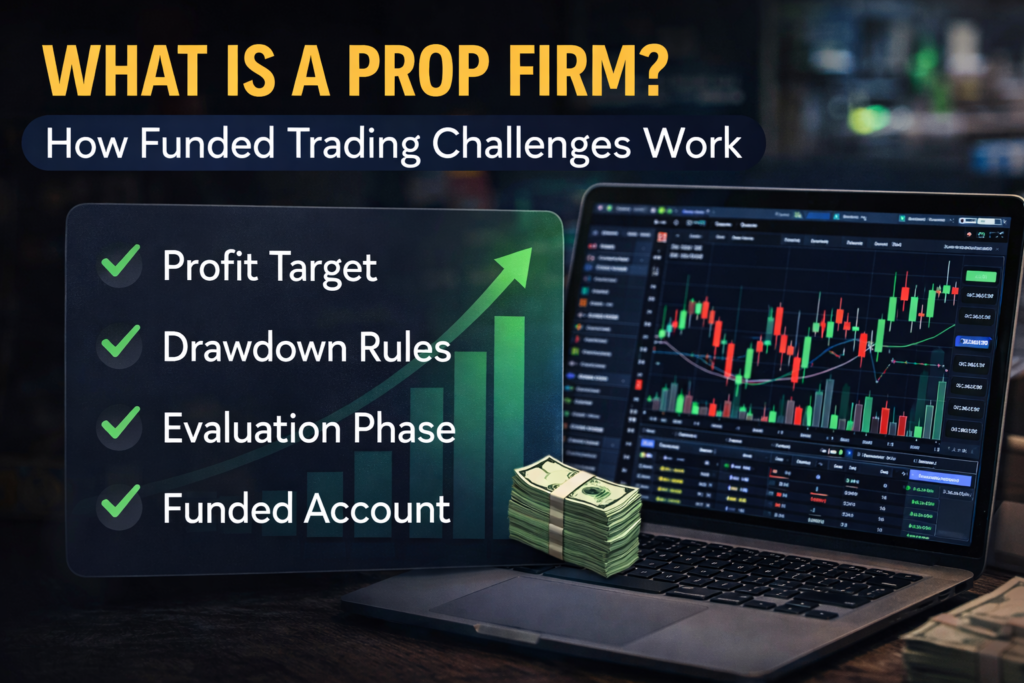
Why Prop Firms Exist
Prop firms are businesses, not trading schools and not investors giving away capital.
Their goal is to identify traders who can follow a structured risk framework. A trader who occasionally makes large profits but also takes large losses is unpredictable. A trader who controls losses consistently can be scaled.
The evaluation process exists to answer one question:
Can this trader protect capital?
This helps beginners stop viewing the challenge as a race and start viewing it as a behavior test.
How Prop Firms Make Money
Many beginners misunderstand how prop firms operate.
Prop firms make money through:
- challenge fees paid by traders
- risk management structures
- scaling successful traders over time
Not every trader receives a funded account. The evaluation process ensures that only traders who can follow rules consistently are given access to capital.
This is why discipline matters more than strategy in most prop firm environments.
What Is a Prop Firm?
A proprietary trading firm (prop firm) is a company that allows traders to trade with the firm’s capital instead of their own money.
Instead of depositing thousands of dollars into a broker account, a trader pays a smaller evaluation fee. The trader must then follow strict risk rules over a testing period. If the trader passes the evaluation, the firm provides a funded account and the trader earns a percentage of the profits.
In simple terms:
You are not being hired.
You are being tested.
The prop firm’s business model is built around identifying traders who can control risk, not traders who can win a few trades.
How Prop Firm Challenges Fit In
Most prop firms use an evaluation process called a prop firm challenge.
Instead of giving traders immediate access to capital, firms require them to pass a structured test that measures:
- risk management
- discipline
- consistency
👉 To understand how this process works in detail, read:
How Prop Firm Challenges Actually Work
My First Challenge Experience
When I first attempted a funded challenge, I made the same mistake many beginners make. I rushed trades, increased position size trying to pass quickly, and treated the evaluation like a short-term opportunity instead of a discipline test. It took several failed attempts before I understood the firms were not testing profitability; they were testing consistency. Once I slowed down and focused on protecting the account rather than growing it quickly, my results improved significantly.
Why Most Traders Struggle With Prop Firms
Most traders do not fail because they cannot read charts.
They struggle because they:
- misunderstand risk rules
- trade too aggressively
- rush the evaluation process
- treat the challenge like a race
Prop firms are designed to expose these behaviors.
👉 For a deeper breakdown, read:
Why Most Traders Fail Prop Firm Challenges
Should Beginners Start With a Funded Challenge?
A funded account can be a powerful opportunity, but only when approached correctly.
Before attempting a prop firm challenge, a trader should already understand:
• basic risk management
• position sizing
• how drawdown works
• realistic return expectations
Without those, the evaluation fee becomes tuition instead of opportunity.
A funded challenge should come after education and preparation, not before it.
For a step-by-step starting point, read the beginner guide here: Beginner Forex Guide
Are Prop Firms Worth It?
Prop firms can be a powerful opportunity for traders who are disciplined.
They allow traders to:
- access larger capital
- limit personal financial risk
- scale their trading over time
However, they are not shortcuts.
Traders who succeed treat prop firm challenges like a professional environment, not a quick way to make money.
Final Thoughts
A prop firm is not just a company that gives traders capital.
It is a structured system designed to identify traders who can manage risk and follow rules under pressure.
Before attempting a challenge, focus on understanding:
- risk management
- drawdown rules
- discipline
Those factors matter far more than strategy alone.
Transparency & Disclosure
TraderDecisions is an educational website.
We do not sell signals, trading systems, or financial advice.
Trading involves significant risk and most retail traders lose money. The purpose of this website is to help traders understand rules, risk, and realistic expectations before risking capital.
Some links on this site may be affiliate links, which means we may earn a commission at no extra cost to you. This does not influence our reviews; firms are discussed based on trader usability and beginner safety.
About the Author
Orbin Johnson is an active forex trader focused on risk management, funded accounts, and beginner trader education. His work centers on helping new traders avoid common early mistakes before risking real capital.